
Stress is not a modern invention
Long before our time, the ancient Chinese already knew exile, loss, uncertainty and downfall. But they did not always respond with struggle or complaint. Through three great figures of Chinese history, we discover another way of going through adversity: not making all tension disappear, but finding, at the very heart of the ordeal, a form of balance.
Su Shi: turning adversity into an art of living
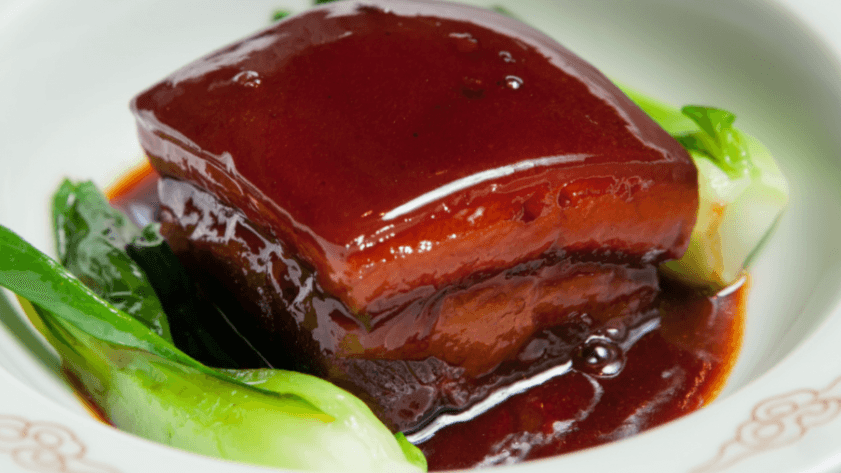
Among the great figures of Chinese culture, Su Shi holds a special place. A major poet of the Song dynasty, calligrapher, thinker and statesman, he remains one of the most beloved authors in China, not only for his literary genius, but also for his deeply human way of living through hardship.
At forty-four, after a political affair that nearly cost him his life, he was sent to Huangzhou, far from the court and his former duties. For many, such a disgrace would have meant bitterness or withdrawal. With him, something else happened: an undiminished attention to what surrounded him. Barely arrived, he wrote: "the river that encircles the town offers fine fish, and the bamboo-covered hills already hint at the fragrance of young shoots". Everything is already in this sentence: where others would have seen only a place of exile, Su Shi kept noticing what remained alive around him.
This is one of the most remarkable traits of his character. Su Shi loved good food, of course, and tradition would later associate him with the famous Dongpo pork. But what is more striking is that he did not reserve his attention for rare delicacies. In his writings, an ordinary fish, a vegetable soup or a bean porridge become worthy of celebration. Scholars point out that before him, everyday foods rarely entered the realm of poetry; with Su Shi, they found their full place there [1].
Even in the hardest times, this sensitivity never left him. Later, exiled to the far south, he discovered the lychees of Lingnan and wrote with humour: "Eating three hundred a day, I would not mind living in the south forever."
Cooking, tasting, writing, observing: with Su Shi, these gestures are never trivial. They allowed him to stay connected to the world and preserve a form of balance, even when everything was shaking. More than a lover of fine food, Su Shi thus appears as a man able to give flavour back to difficult days: with him, even the simplest things become a way of continuing to live fully.
Zhang Dai: writing to hold on to a vanished world
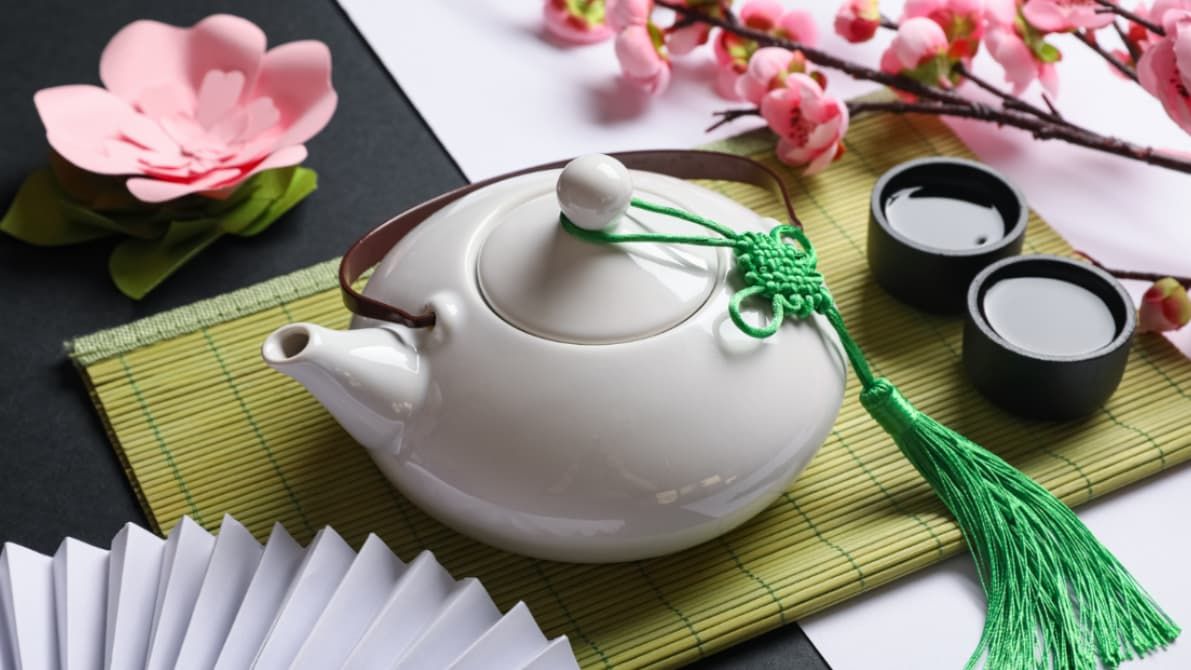
Faced with hardship, Zhang Dai responded differently: through memory. Born in 1597 into a great aristocratic family in Shaoxing, Zhang Dai grew up in a world of extreme refinement. He described himself as a man passionate about beautiful residences, theatre, delicate dishes, lanterns, antiques and, above all, tea. As a young man, he frequented private theatres, gardens and literary salons, and travelled through the great cities of Jiangnan. He grew up in a world where pleasure, art and elegance were taken for granted.
This world disappeared with the fall of the Ming. When the dynasty collapsed, Zhang Dai was forty-six. His family was ruined, the world he had known faded away, and he himself ended up in great poverty. Zhang Dai, for his part, began to write. In Tao'an Mengyi (Dream Recollections of Tao'an), he set out to save through memory what history had destroyed: a lantern festival on the shores of West Lake, an evening at the opera, a night-time stroll, a moment of shared tea. His memories are not mere nostalgia: they rescue a vanished world from oblivion.
This is where his work takes on its full power. Where others would have recounted their losses, Zhang Dai pieced back together, fragment by fragment, what reality had wiped away. Writing became for him a way of preserving, on the page, an order and a beauty that time had destroyed.
His relationship with tea reveals the same sensitivity. In his writings, preparing tea is never a banal gesture: he chooses the water with care, admires the whiteness of the porcelain, describes the silence of a room, the light of a lamp, the moonlight on a clean table. In his pages, every detail still seems to preserve something of the past [2].
For Zhang Dai, writing thus amounts to the same gesture as serving tea: keeping a trace of what no longer exists. Faced with upheaval, he simply goes on bringing to life, in his pages, the world he has lost.
Tao Yuanming: living true to yourself
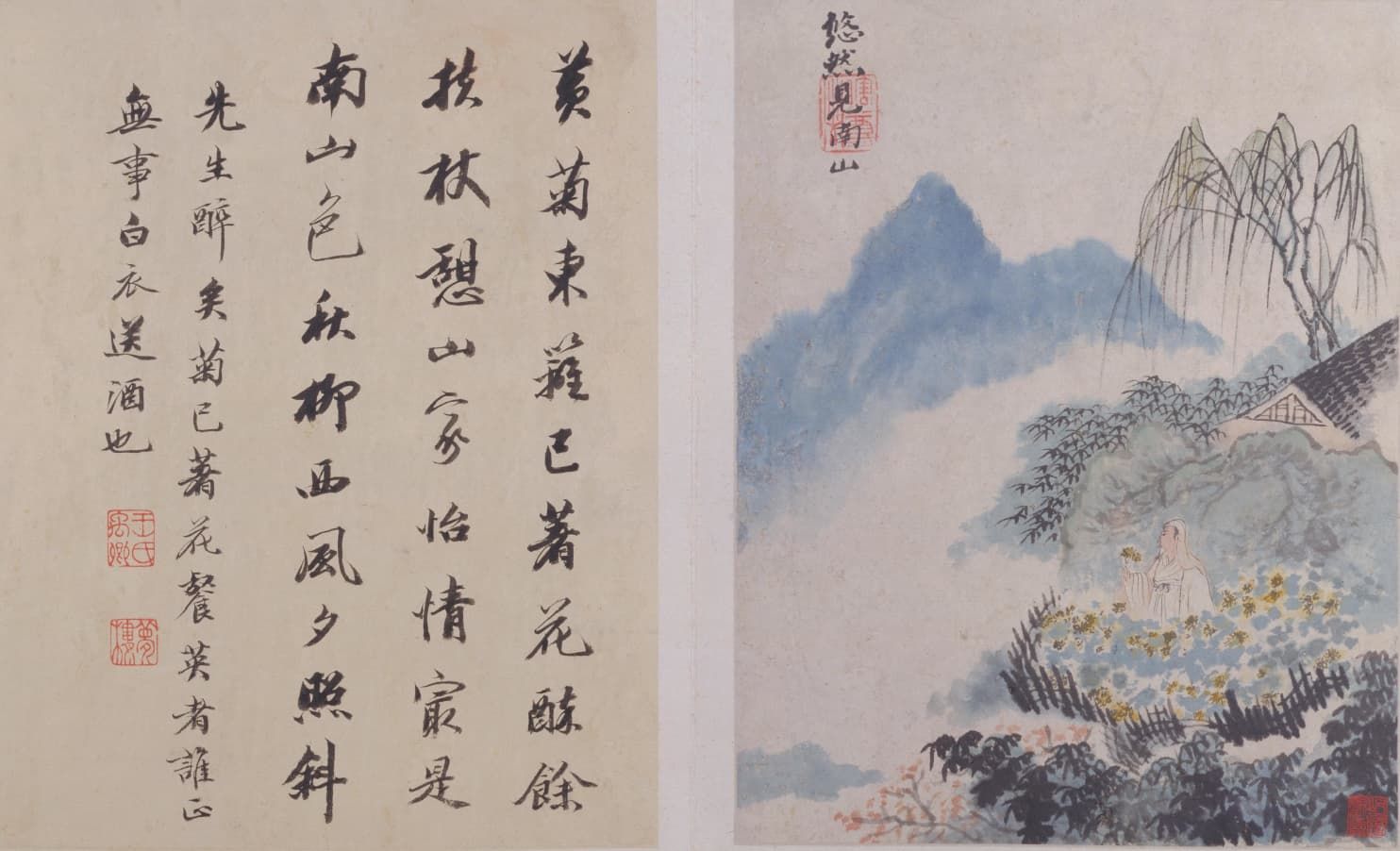
Long before Su Shi and Zhang Dai, Tao Yuanming embodied another way of facing hardship: choosing to live by one's own principles. A 4th-century poet under the Eastern Jin, he held several minor administrative posts, but put up poorly with the compromises of official life. At forty-one, while serving as a district magistrate, he gave up his post and left public life for good.
Tradition has kept the phrase that sums up this choice: he refused to "bow and scrape for five pecks of rice". In China, this phrase has become much more than a biographical episode: it expresses the refusal to sacrifice one's inner freedom to a life that no longer feels like one's own. Tao Yuanming then returned to the countryside, to his native region. The life he found there was simple, often hard: he farmed his land, suffered poor harvests, lived in poverty. Yet he never went back on his decision. This departure was not an escape, but a way of staying true to himself.
It was in this frugal existence that he wrote his most famous poems. His verses say little about heroism, but pay constant attention to simple things: picking chrysanthemums, walking along a dirt path, gazing at the distant mountain, drinking a little wine after working in the fields. His best-known poem gives the perfect image of this, lines so famous that they were also read by Sophie Marceau in a tribute to Chinese poetry:
"Picking chrysanthemums beneath the eastern hedge, at ease I see the southern hills I love."
For Tao Yuanming, this simplicity is never a poverty of vision. It reflects a deep conviction: you can live in the midst of the world without letting it overwhelm you entirely. In another famous line, he writes: "I built my house among the dwellings of men, and yet I hear no noise of carriage or horse." Peace, for him, does not come from total isolation, but from the inner distance you keep from the tumult.
This is no doubt why he remains such an important figure in Chinese culture. More than a poet withdrawn from the world, Tao Yuanming has become the symbol of a rare choice: giving up what exhausts you to preserve what matters. Faced with turmoil, he seeks neither to fight harder nor to adapt at all costs; he simply chooses to live differently [3].
The same wisdom in the face of hardship
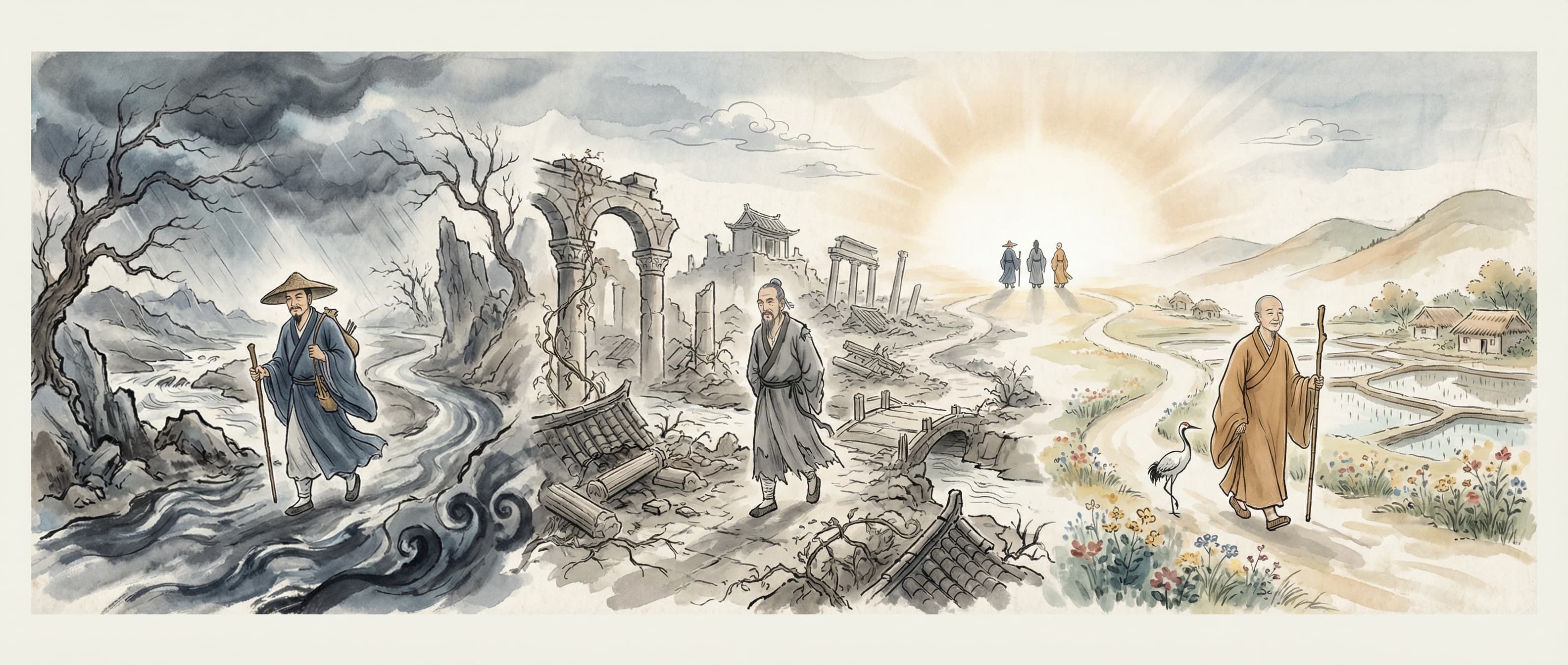
Su Shi, Zhang Dai and Tao Yuanming neither lived in the same era nor went through the same ordeals. But all three shared the same refusal: to let hardship define their lives entirely.
Beyond their individual paths, a shared vision emerges. In China, their poems are still learned from childhood and passed down from generation to generation. If they have come down through the centuries, it is because their words continue to offer much more than a literary heritage: a way of going through hardship with clarity and serenity.
This wisdom is deeply rooted in traditional Chinese thought. It is not always about defeating adversity, but about preserving an inner balance that outside circumstances should not entirely break.
This is also one of the principles of Traditional Chinese Medicine: stress is not seen only as a tension to be removed, but as the sign of an imbalance between body, mind and environment. Regaining calm does not mean abolishing all pressure, but restoring a more harmonious flow.
Faced with turmoil, it is not always about resisting harder, but sometimes also about learning to preserve a form of balance within yourself.
References:
[1] MO Lifeng, From Tao Yuanming to Su Shi: the poetic elevation of the theme of food. Wenxue Yichan (Literary Heritage). 2010(2):4–15.
[2] ZHANG Zhifan, From Zhang Dai's "Su ci chuan jing ye" to the aesthetics of tea life in the late Ming. Journal of Guizhou University of Engineering Science. 2024;42(4):90–96.
[3] WEI Fengjuan, On Tao Yuanming's spiritual realm and the cultural model he represents. Wenxue Yichan (Literary Heritage). 1994(2):22–31.