- The four flowers of balance
- The breath of the belly: release, purify
- The light of the gaze: clarify, soothe
- Rhythm regained: harmonise
- A ritual of clarity and slowness


In a world that breathes too fast, where bodies wear themselves out trying to keep up, medicinal flowers remind us of an ancient truth: balance begins with the breath.
Chamomiles and chrysanthemums do not cure; they bring body and mind back into tune. They give the body back its rhythm and the mind its clarity, and invite light to flow once more.
Rediscover this living connection: a floral journey through the body from the inside out, from a calm belly to a clear gaze.
Four flowers, four temperaments, four ways of breathing.
Together, they make up a ritual of clarity and balance for everyday life.
The four flowers of balance

To help you better understand their benefits and choose the one that suits you, here are the four flowers of our floral serenity ritual.
| Flower | Active compounds | Benefits | Precautions |
|---|---|---|---|
|
Roman chamomile
(Chamaemelum nobile L.) |
Polysaccharides: ★★☆☆☆ Flavonoids: ★★★☆☆ Coumarins: ★★★☆☆ |
Detoxifying and relaxing, it helps promote a feeling of lightness after meals and relax the abdominal area. It eases digestive discomfort and brings a moment of relaxation during times of stress or discomfort linked to the female cycle. Ideal for people looking for support during times of tension, bloating or minor menstrual discomfort. | Not recommended during pregnancy. |
|
German chamomile
(Matricaria chamomilla) |
Coumarins: ★★★☆☆ |
Helps purify the digestive system and promotes the flow of air through the respiratory tract. Helps ease feelings of digestive discomfort and supports slow digestive processes. In TCM, it promotes harmony by calming irritation, tension and mild sensations of heat. Ideal for those who want to feel more comfortable with slow digestion, bloating or a mild cough associated with internal imbalances. | Not recommended during pregnancy. |
|
Chinese chamomile – Ju hua (hang)
(Chrysanthemum indicum) |
Flavonoids: ★★★★★ Phenolic acids: ★★★★☆ Terpenes: ★★★☆☆ Polysaccharides: ★★★☆☆ |
Clarifying and refreshing, it supports the balance of the Liver and Lungs, helps maintain clear vision and calms the mind. It promotes visual comfort, especially after long hours in front of screens. In TCM, it is reputed to promote mental clarity and ease internal tension. Ideal for those looking for support during periods of stress, eye strain or feelings of internal heat. | Not recommended during pregnancy. Avoid in case of severe fatigue, digestive cold or diarrhoea. |
|
Chinese chamomile buds – Ju hua (tai)
(Chrysanthemum indicum) |
Flavonoids: ★★★★☆ Polyphenols: ★★★★☆ Polysaccharides: ★★★☆☆ |
Softening and protective for the eyes – Eases eye strain, nourishes the Liver and moistens Yin. Less "cold" than Ju Hua Hang, it is better suited to sensitive or tired constitutions. In TCM, it balances Liver heat and keeps vision clear. Ideal for daily use, for people looking for gentle, balancing eye care. | Not recommended during pregnancy. Avoid in case of severe fatigue, digestive cold or diarrhoea. |
★★★★★: Very high content (>15% of dry weight)
★★★★☆: High content (8–15%)
★★★☆☆: Medium content (4–8%)
★★☆☆☆: Moderate content (1–4%)
A little tip:
- You want to detox and ease abdominal tension – Roman chamomile
- You have mild digestive or respiratory complaints – German chamomile
- You suffer from eye strain, internal heat or mental stress – Chinese chamomile
- You're looking for gentle, daily, balancing eye care – Chinese chamomile buds
Each flower has its own personality, its own breath and its own light. By discovering them, you learn to listen to your own rhythm: to find, in a simple cup, a balance that suits you.
The breath of the belly: release, purify

It all begins at the centre of the body, where breath and emotion meet.
When the belly tightens, it is often a sign that the breath has been lost.
This is where Roman chamomile comes in: a gentle, enveloping flower that helps release deep tension and get through periods more comfortably. It soothes digestive spasms, supports sensitive stomachs and softens days of hormonal imbalance. Its quiet warmth relaxes without tiring, like a balm for body and mind.
Alongside it, German chamomile brings a fresher breath. It purifies, frees and lightens what is clogging things up: digestive heaviness, blocked airways, heavy thoughts. An infusion of German chamomile is like opening a window in a stuffy room: the air circulates again.
The chamomiles of the West teach us the first step in coming back to ourselves: breathing through the body, regaining the fluidity of the centre.
The light of the gaze: clarify, soothe

When the breath returns, the light can rise. The gaze clears, the head clears, the mind settles. In Traditional Chinese Medicine, it is said that "the Liver opens into the eyes": where energy flows, vision becomes clear.
Ju Hua Hang, the chrysanthemum of Zhejiang, is the flower of this clarity. It nourishes the Liver and Lungs, refreshes the body and relieves eye strain and headaches. Its gentle, slightly sweet flavour evokes a summer morning: calm, bright and full of promise.
Ju Hua Tai, more delicate, is its night-time version. Its closed buds contain the essence of rest. It nourishes Yin, moistens and protects tired eyes: like soft lighting in the heart of the evening.
These chrysanthemums of the East take over from the chamomiles: after calm comes clarity; after breath comes light.
Rhythm regained: harmonise
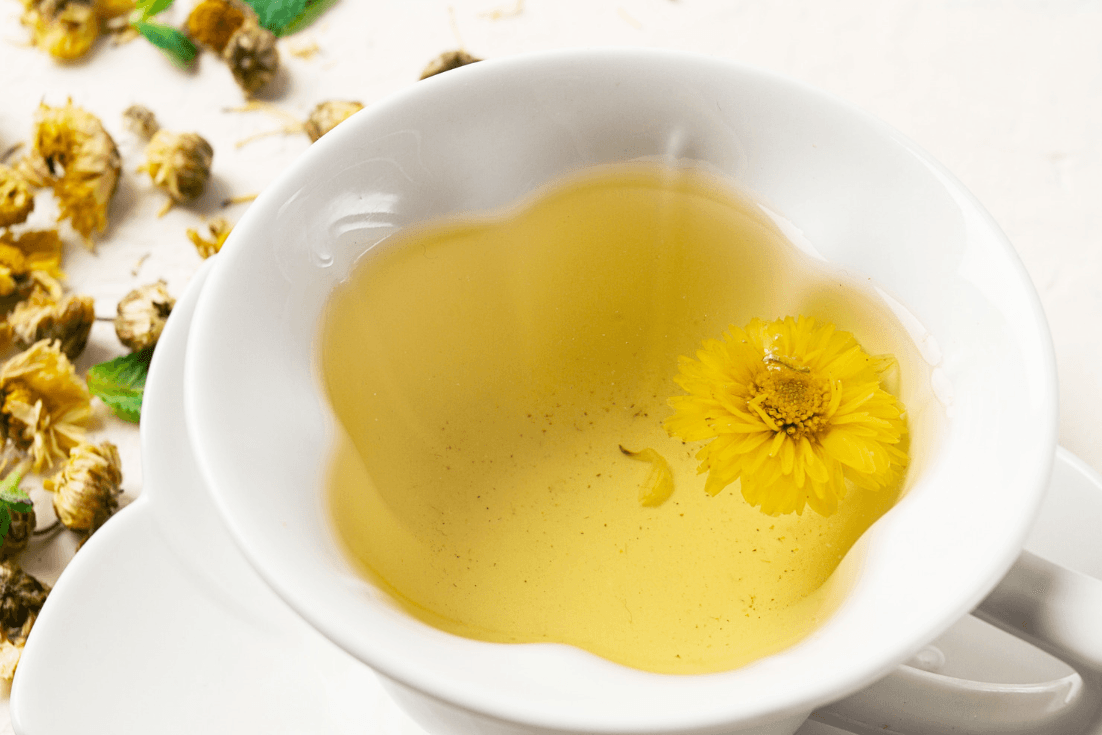
When the belly relaxes and the gaze brightens, energy regains its natural flow. Tension gives way to the right movement, that of Qi flowing freely.
This is where the four flowers answer one another like the seasons:
- German chamomile cleanses,
- Roman chamomile relaxes,
- Ju Hua Hang clarifies,
- Ju Hua Tai nourishes and softens.
Together, they make up a complete breath: a melody of balance, where each note has its place: freshness, gentleness, clarity, peace.
Harmonising is not about seeking perfection: it is about learning to listen to the body's rhythm, and to breathe with the flowers.
A ritual of clarity and slowness
In a cup of infusion, there is not just a plant: there is an invitation to slow down, to breathe, to restore light between body and mind. Each flower becomes a breath, each sip a way of coming back to yourself.