- What is porridge?
- Zhōu (or congee): Chinese rice porridge
- Congee to take care of the Spleen
- How do you make zhōu?
- Our congee recipes
- Congee with lotus seeds and poria
- Congee with sesame and black beans
- Congee with goji and tremella
- Congee with longan and peanuts


Chinese dietetics: congee to take care of your Spleen during the inter-season

Having become popular in Europe in recent years, porridge (or “gruel”) has been the favourite breakfast of the Chinese for centuries. Indeed, as well as being delicious and filling, porridge has many health benefits: it fights fatigue, regulates intestinal transit and can even contribute to weight loss!
In traditional Chinese medicine, porridge is reputed to tonify the Spleen. Which is good timing, since we are currently in the inter-season and the Spleen is the organ associated with it!
What is porridge?
Known the world over by its English name, porridge, this dish, also called “gruel” (a much less elegant name, admittedly), refers to a traditional preparation made from degermed cereal grains, usually mixed with water or milk. Very popular in Germany and the United Kingdom, porridge (usually made from oats) is eaten in many ways (cold, hot, sweet, savoury, etc.) and is praised as athletes’ favourite breakfast recipe.
This preparation, though as old as the hills, is all the rage in the West since, as well as being economical, it is also healthy (in other words, “good for you”). Indeed, porridge is recognised as having many benefits, notably for intestinal transit (rich in fibre), for lowering bad cholesterol and for preventing cardiovascular disease.
In China, porridge is a very popular traditional dish, generally eaten to treat or prevent discomforts. Indeed, Chinese dietetics lists as many porridge recipes as there are ailments.
Zhōu (or congee): Chinese rice porridge

Also very popular at breakfast, the porridges of Chinese dietetics nonetheless differ from Western porridge because they are generally made from rice. These rice porridges are called Congee. The Chinese, for their part, call them zhōu.
Being particularly easy to digest, zhōu are reputed to be effective at soothing digestive problems. However, their benefits are not limited to these effects alone. Rice congee is reputed to:
- be nourishing and satisfying (it helps avoid snacking and can even promote weight loss)
- be refreshing and light
- boost energy (and treat fatigue)
- anchor the Earth
- improve concentration
An infinite number of combinations is possible depending on taste and purpose: fruit, vegetables, spices and even medicinal plants are often added to zhōu.
Congee to take care of the Spleen
 According to Chinese dietetics, the main role of congee is to tonify the Spleen and the Stomach, organs that are essential to digestion. Sweet in flavour and neutral in nature, cooked cereals strengthen the Spleen and stimulate its Qi. That is why congee is a breakfast of choice in Asia!
Conversely, the breakfasts we are used to in the West (bread and butter, pastries, orange juice…) cause an excess of coolness in the body and weaken the Spleen and our energy. Chinese dietetics therefore recommends eating warm, cooked foods in the morning to preserve the Spleen and gently activate the digestive process.
Besides its role in digestion, the Spleen takes on other functions that make it worth watching its balance carefully. In traditional Chinese medicine, the Spleen:
- governs the digestive functions
- produces Qi and Blood
- controls the transportation and transformation of Fluids
- controls the Blood
- houses the Yi (the Intellect)
- governs the muscles and the limbs
There is no need to labour its importance within our body. Taking care of it is essential… And that is exactly what zhōu does!
What is more, according to the Chinese calendar, we have just entered the inter-season, also called “the fifth season”. The inter-season is precisely the season associated with the Spleen. One more reason to swap our croissants and pains au chocolat for a rice congee!
How do you make zhōu?
Zhōu is made from rice cooked for a long time (at least 30 minutes, or even longer depending on the ingredients added) in plenty of water, until it turns into a porridge.
In some cases, congees contain no rice. This is the case with our congees inspired by Chinese dietetics. Made from medicinal plants (mainly seeds, mushrooms and dried fruit), these zhōu are not only good for your health but also absolutely delicious!
Our congee recipes
Congee with lotus seeds and poria
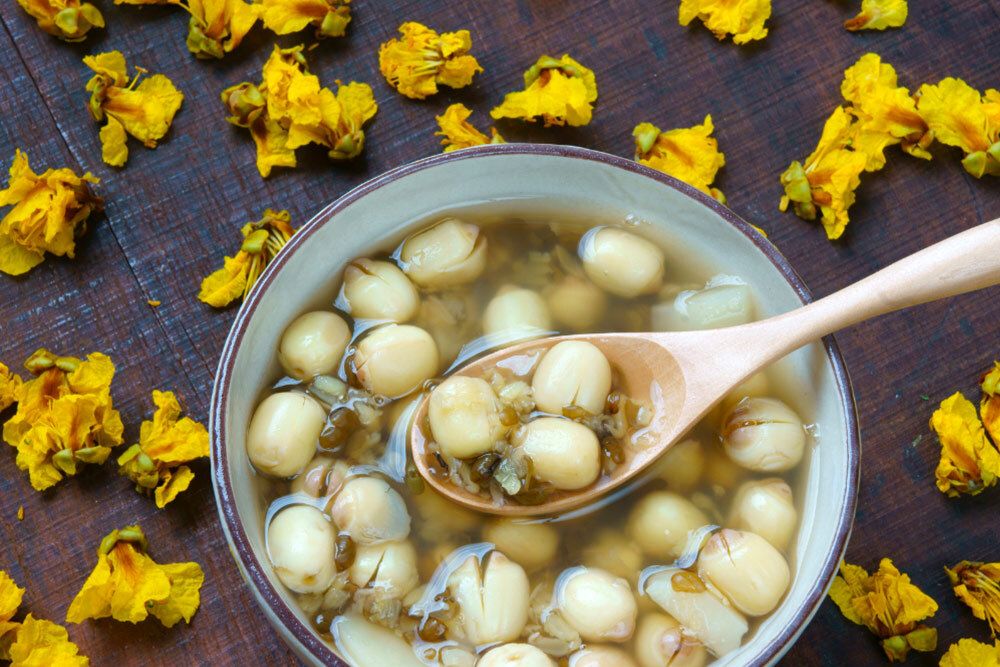
The congee made with lotus (Lian zi in Chinese) and poria (Fu ling), called Shui run yang bai zhou, is an ideal preparation for clearing Heat and detoxifying the body.
It is made up of:
- Bai he (lily bulbs)
- Fu ling (poria)
- Lian zi (lotus seeds)
- Yi yi ren (Job’s tears)
- Hua sheng (peanuts)
To prepare this congee: Soak the Fu ling in water for 12 hours and the other ingredients for 1 hour. Once this is done, place the ingredients in a saucepan of water and bring to the boil.
Leave to cook for 30 to 45 minutes. Add milk or sugar to taste, and enjoy.
Congee with sesame and black beans
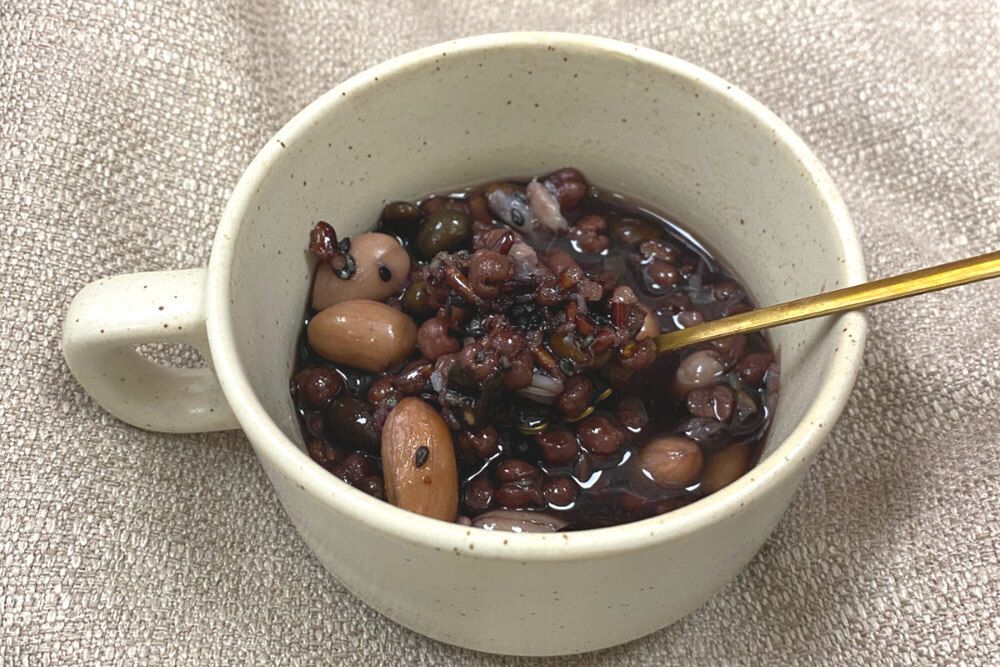
The congee made with black sesame (Hei zhi ma in Chinese) and black beans (Hei dou), called Wu hei yang fa zhou, is a tasty recipe that helps to revitalise the hair and strengthen hair health.
It is made up of:
- Bai he (lily bulbs)
- Hei zhi ma (black sesame)
- Yi yi ren (Job’s tears)
- Hei nuo mi (glutinous rice)
- Hei dou (black soya beans)
- Hua sheng (peanut)
To prepare this congee:
Soak the soya beans in water for 12 hours and all the other ingredients for 1 hour. Once this is done, place the ingredients in a saucepan of water and bring to the boil.
Leave to cook for 30 to 45 minutes. Add sugar if you wish.
Congee with goji and tremella
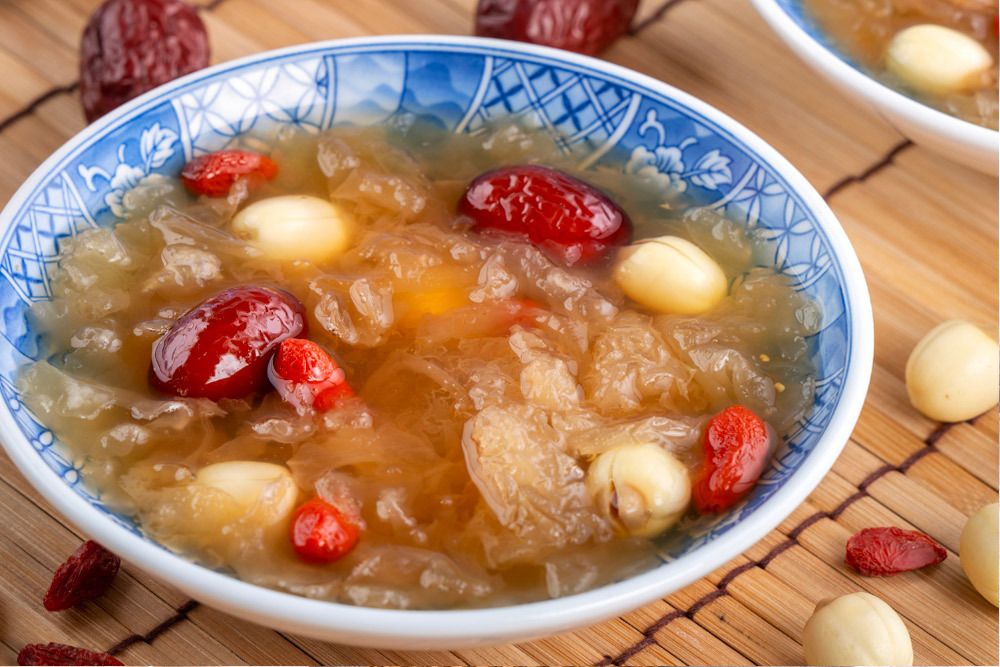
The congee made with goji (Gou qi zi in Chinese) and tremella (Yin mu er), called Yang yan yin er zhou, is a very popular recipe in China. Made with several plants, this preparation is reputed to nourish Yin, drive out heat and moisten the Lung. But it is above all used for its benefits for the beauty of the skin.
It is made up of:
- Yin mu er (snow fungus)
- Gou qi zi (goji berries)
- Lian zi (lotus seeds)
- Xiao mi (millet)
- Xiao zao (jujube)
To prepare this congee:
Soak all the ingredients in water for 1 hour. Bring to the boil, then leave everything to cook for 30 to 45 minutes. Finally, add sugar and enjoy.
Congee with longan and peanuts
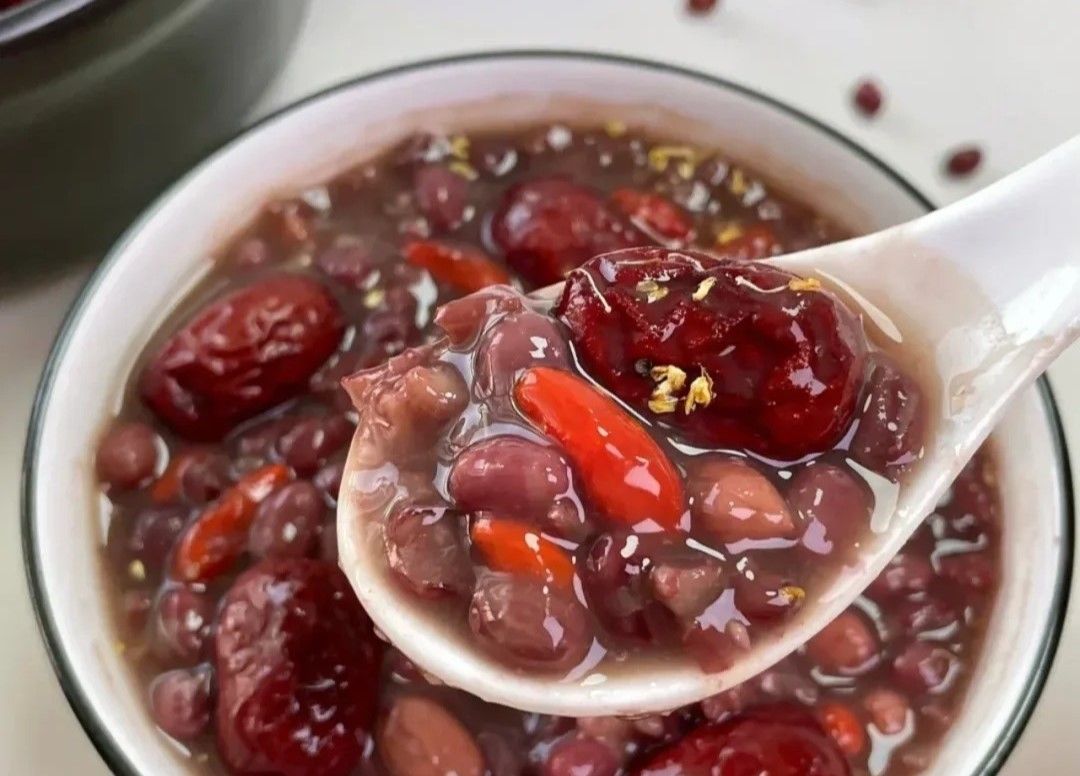
Longan and peanut congee, known as Bu xue wu hong zhou in Chinese dietetics, is an enriching recipe that combines the nourishing virtues of longan (Long yan rou) and peanuts (Hua sheng). This preparation is famous for its beneficial effects on Blood and Qi, thereby promoting vitality and health. Ideal for anyone looking to improve their general well-being, this congee is also known for its properties that improve the appearance of the skin, offering a natural and effective beauty treatment from within.
It is made up of:
- Long yan rou (longan)
- Hua sheng (peanuts)
- Hong dou (red beans)
- Nuo mi (glutinous rice)
- Xiao zao (jujube)
- Gou qi (goji berries)
To prepare this congee:
Soak the red beans (Hong dou) in about 5 cm of water for 12 hours. Soak all the other ingredients in water for 1 hour. Then bring to the boil and leave everything to cook for 30 to 45 minutes. Add brown sugar to taste, and enjoy.

A good breakfast should give our body all the energy it needs to get through the day. So, according to the principles of Chinese dietetics, there is nothing better than zhōu to start the day on the right foot. Delicious, economical and very easy to digest, it will replace (with no regrets) breakfasts that are too rich in carbohydrates and fats, to the great delight of the Spleen!
Discover all our congees by clicking on this link.

