
An integral part of our daily lives, music sets the rhythm of our lives. From a very young age and, it seems, even before birth, human beings are sensitive to sounds, harmony and rhythm. In many cultures, music is seen as a powerful remedy with the power to soothe our pain and our sorrows. The birth of music therapy, or therapy through music, is therefore nothing new; quite the contrary, it goes back centuries, even millennia. What are the origins and benefits of this form of treatment? How does Traditional Chinese Medicine use sound to heal body and mind?
The origins of music therapy
From Antiquity onwards, thinkers reflected on the importance of music, its effects on the soul and its impact on the world. Later, in the 20th century, when the notion of the psyche took over from that of the soul, psychologists established a new treatment alternative based on sound and vibration: music therapy. It is said that music therapy was used more widely after the First World War in an attempt to ease the trauma experienced by soldiers.
In Traditional Chinese Medicine, the first traces of music therapy date back to five centuries BC. Over time, doctors developed an approach that incorporated musical notes and instruments into healing by placing them within the theory of the Five Movements (also called elements), a fundamental notion in Chinese thought.
Chinese music therapy
The link between the Five Elements and music
“Whoever knows the world and its rhythms will also know man and the rhythm of his life, and whoever knows these harmonies will need to know nothing more”
Taken from the Yellow Emperor's Inner Classic (Huangdi Nei Jing), the oldest work of traditional Chinese medicine, this sentence expresses how TCM sees the human being: a being who follows their own rhythms and those of the universe around them.
In Traditional Chinese Medicine, the natural cycles of growth and decline are linked to the alternation of Yin and Yang and to the theory of the Five Movements. While the notion of Yin and Yang makes it possible to classify the things of the world by dividing phenomena into two opposite but complementary aspects, the theory of the Five Movements refers to the five stages of the cyclical formation generated by the alternation of Yin and Yang and, by extension, to the five modes of expression of Nature and of Man.
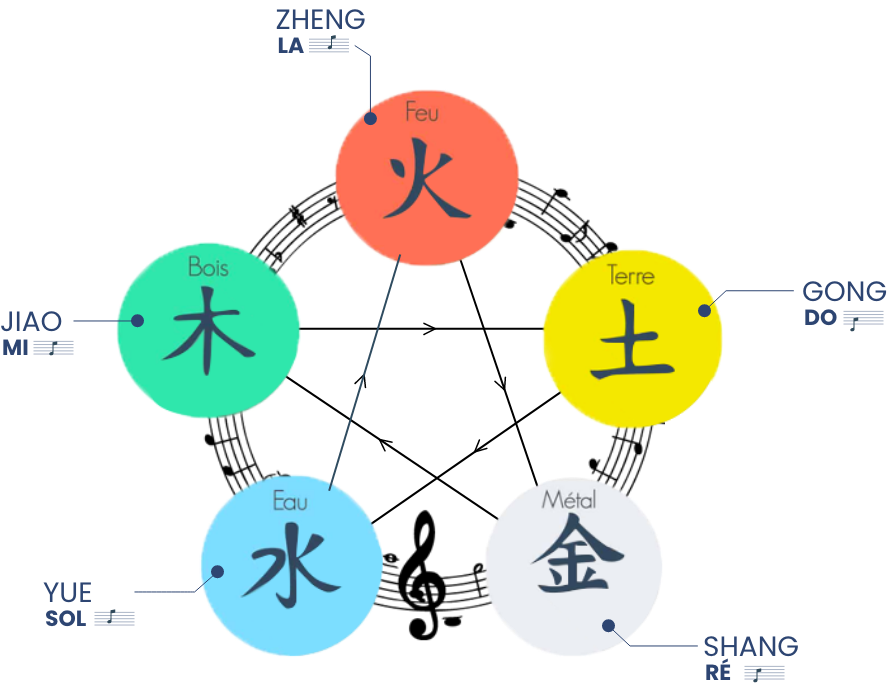
In his book The Chinese World1, the sinologist Jacques Gernet states that the five types of manifestation of Qi are represented by Wood, Fire, Earth, Metal and Water, which together make up the Five Movements. They correspond to other criteria such as the seasons, the emotions, the senses and musical notes. The Five Elements thus refer to five notes: Gong (do), Shang (re), Jiao (mi), Zhi (sol) and Yu (la). According to The Edge2, a magazine that explores aspects of holistic living, integrative approaches to complementary healing and the intuitive arts:
- The note corresponding to the Earth element is Gong (Do). It helps strengthen the Spleen.
- The note Shang (Re) corresponds to the Metal element. It protects and nourishes the Yin of the Lung.
- The note corresponding to the Wood element is Jiao (Mi). It promotes the circulation of Liver Qi and soothes nervous disorders.
- The note corresponding to the Fire element is Zhi (Sol). It acts on the Heart.
- The note Yu (La) is linked to the Water element. It nourishes Kidney Yin, protects the Jing (Essence) and calms Lung Fire.
In addition, recent research published in the English-language journal Medicine3, which publishes across a wide range of scientific and medical disciplines, affirmed the effectiveness of Chinese music therapy on anxiety and depressive disorders in patients with lung cancer.
The effects of musical instruments on the organs
“Harmony between music and man, harmony between heaven and man.” – Chinese saying
As well as being based on musical notes, music therapy relies on the relationship between the internal organs and musical instruments. The sages of old believed that each organ of our body had its own rhythm and that different sounds had a considerable effect on our body: low sounds were thought to resonate in the abdominal region and high sounds in the head.
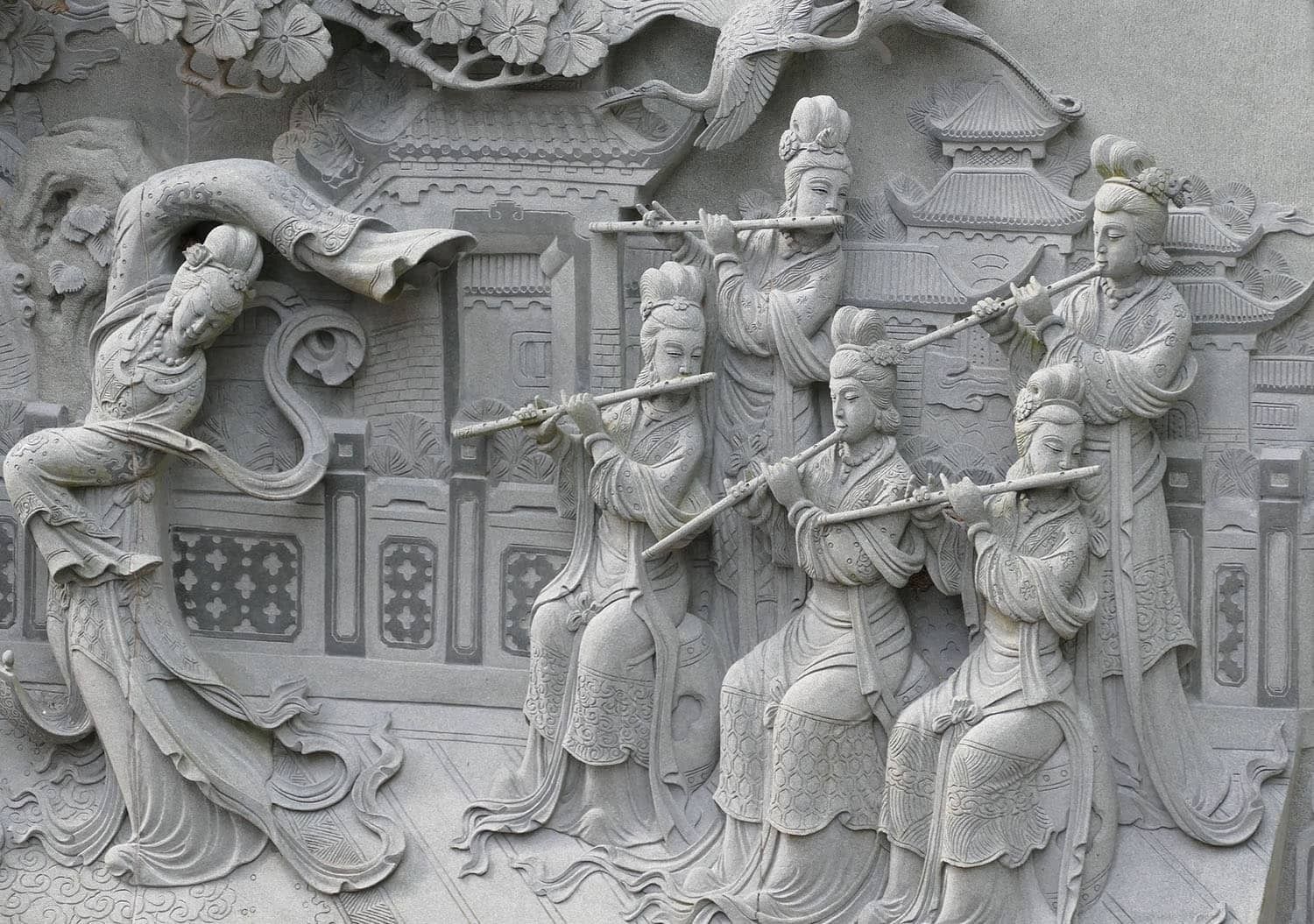
TCM applies this principle to establish connections between musical instruments and the five Zang organs: the Liver, the Heart, the Spleen, the Lung and the Kidneys. These correspondences explain the therapeutic role of musical instruments. The musicology journal Musica et Memoria 4 states that flutes tonify the Liver, strings calm the Heart, the ocarina fortifies the Spleen, bells restore the energy of the Lung and drums tonify the Kidneys.
Acupuncture and music therapy
In Chinese music therapy, sound and acupuncture often go hand in hand. According to ancient texts as well as recent clinical studies, there is a vibrational correspondence between the meridian points stimulated during acupuncture sessions and sounds. When used by acupuncturists, music restores deficiencies, combats excesses and acts on sleep disorders. On an emotional level, it helps dispel negative feelings such as anger, fear, sadness, anxiety or grief. Indeed, according to the English-language Journal of Traditional Chinese Medicine5, which specialises in TCM, a study carried out in 2017 showed that a combination of Chinese music therapy and acupoint stimulation had positive results in patients suffering from post-stroke depression.
So, holistic, comprehensive and innovative, Traditional Chinese Medicine has for centuries succeeded in harnessing the power of sound, a wonderful tool of mediation used to bring well-being and calm.