
An integral part of Chinese philosophy, the theory of the Five Movements, also known as the theory of the Five Elements or Wu Xing in Chinese, is fundamental in traditional Chinese medicine.
Having emerged after the theory of Yin and Yang, the theory of the Five Movements explains the different relationships between the elements that make up nature, as well as their influence on human beings.
What are the five elements and how are they linked to one another?
What are the Five Movements in nature?
Fire, the element of summer
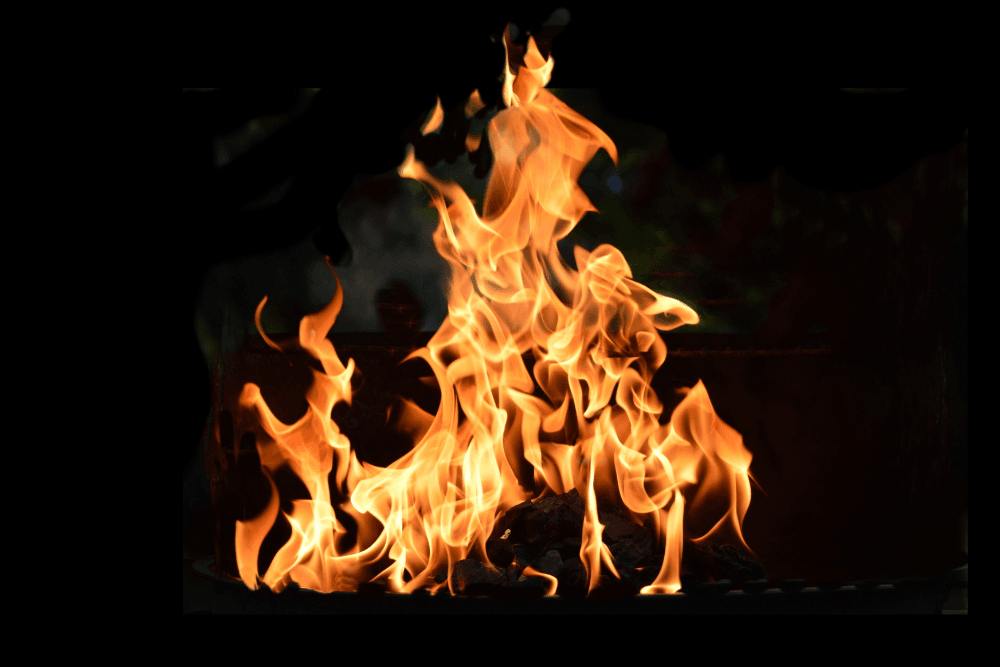 Fire is a Yang element associated with summer, the Heart, joy, strength, affection, the mind, consciousness and enthusiasm.
An ascending movement, Fire produces heat; it brings illumination and overcomes darkness with light.
When Fire is out of balance, symptoms such as insomnia, hot flushes, excessive sweating, blood and pressure disorders, and an excess of joy and libido can arise.
A balanced Fire warms without burning and purifies without devastating. To harmonise this movement, energy exercises such as Qi Gong or Taiji Quan are encouraged. It is also advisable to avoid spicy food, energy drinks and caffeine.
In addition, Fire energy is released when you express yourself enthusiastically through art. Giving free rein to your creativity is therefore highly recommended!
Earth, the element of the inter-season
 While in the West, Earth is often linked to motherhood and fertility, in Chinese culture it constitutes “the body of life”...
Both Yin and Yang, Earth is linked to the inter-season, to the Spleen and the Stomach, and to stability, and it represents rootedness, kindness and the attention we pay to others.
A disturbed Earth can give rise to eating disorders (lack of appetite or excessive appetite) as well as digestive problems. However, a well-nourished Earth gives us a feeling of satiety and allows a healthy relationship with food.
To take care of this very important energy, traditional Chinese medicine advises turning to spices such as cinnamon and nutmeg, known to nourish Earth, and limiting sugar, as eating it slows down the movement of Earth energy.
Metal, the element of autumn
 According to traditional Chinese medicine, Metal energy dominates in autumn and is associated with the Lung. This energy marks the passage from day to night and is closely linked to decline.
Yin by nature, Metal is an element linked to values, altruism, wisdom and meticulousness.
An unbalanced Metal can give rise to sudden breathlessness and a strong feeling of fatigue. Other common symptoms are respiratory discomforts such as a runny nose, congestion, cough or sore throat.
To take care of this energy, it is recommended to turn to plants that strengthen immunity, such as astragalus and ginseng.
Wood, the element of spring
 Symbolising germination and transformation, Wood is Yang by nature and evokes the fine days and the awakening of nature. It is therefore quite natural that Chinese medicine associates it with spring and the Liver.
The energy of Wood calls for development, adventure, intuition, courage and creativity.
When the energy of Wood is disturbed, the Liver and the Shen falter, affecting memory and emotional health. Digestive troubles, migraines, dizziness and also hormonal imbalances can occur as a result of Wood disharmony.
Certain eating habits can strengthen the energy of Wood, such as eating sour-flavoured foods (e.g. chicken, artichoke, grapefruit). In addition, practising certain Qi Gong postures such as “ The tree grows by taking root” or “balancing by harmonising deep emotions" is recommended to balance this energy and awaken inner strength.
Water, the element of winter
 The source of all life in nature, the Water movement refers to insight, introspection, inner strength and self-belief.
In traditional Chinese medicine, Water is the element of winter: it is Yin by nature and is associated with the Kidney.
Water is an energy in constant movement. When it stagnates, symptoms such as dehydration, chills, sleep disorders or agitation can become noticeable.
To take care of this energy, it is advisable to practise activities that encourage calm, such as meditation or Qi gong. Choosing light food and water-rich foods such as cucumber, courgette or celery is also widely recommended.
The relationship between the five elements
While, as we have already seen, each element refers to an organ and a season, these dynamics are closely linked to one another. Their harmony depends on two cycles. These two cycles represent the circulation of energy. They help preserve our health and our balance.
The generating cycle
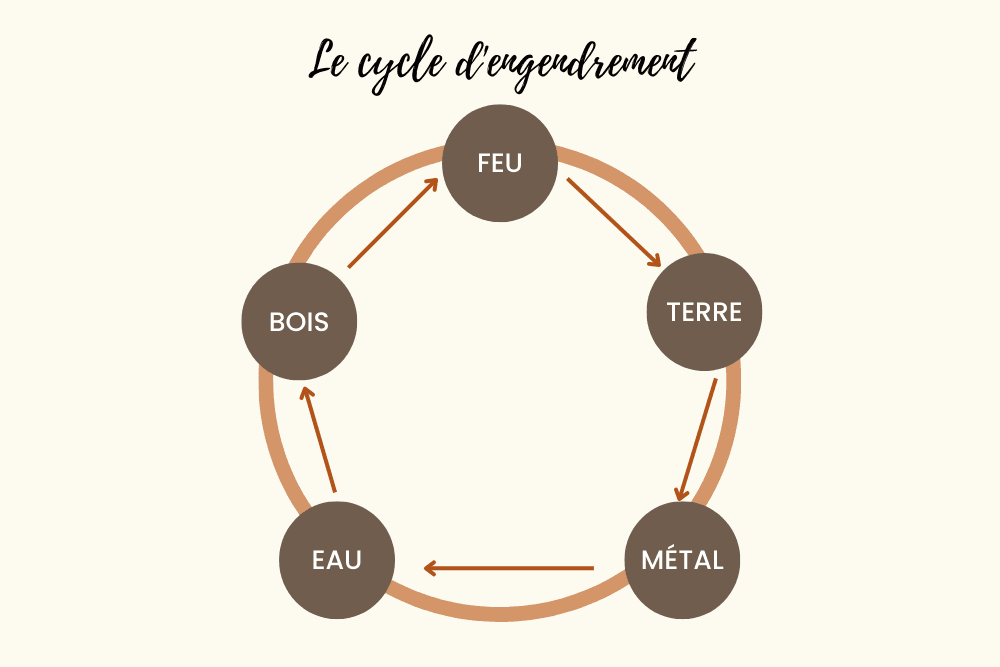 It is also called the creation cycle, or Xiang Sheng in Chinese. Generally symbolised by a “child-parent” relationship, this cycle shows us that each element arises from another and that each element nourishes the next, and so on.
- Wood generates Fire and encourages its growth
- Fire generates Earth by turning substances into ash
- Earth generates Metal
- Metal can liquefy and generate Water
- Water generates Wood
The control cycle
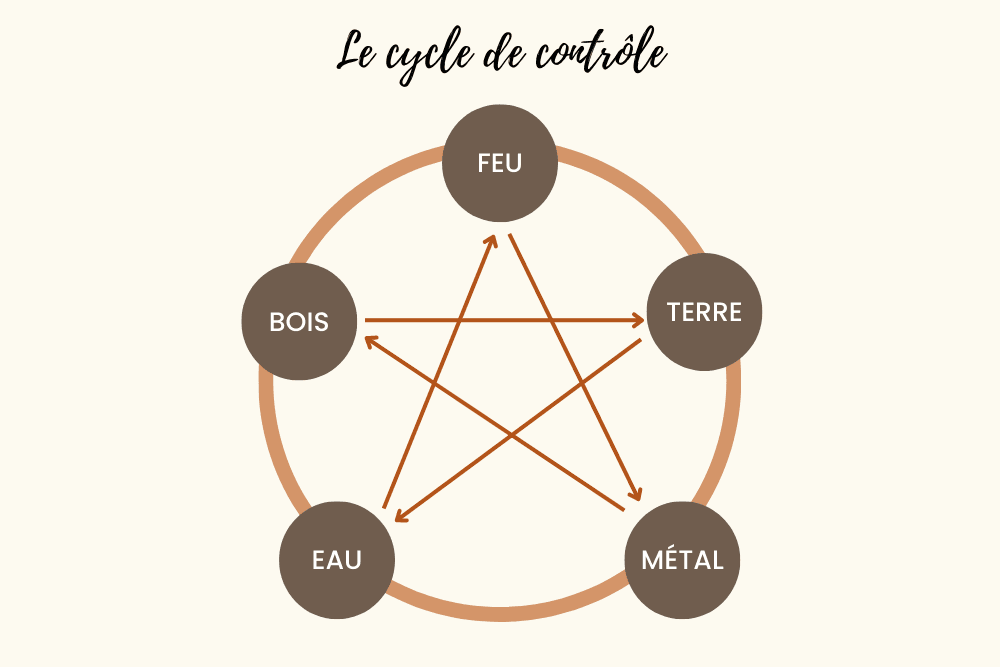 Also known as the “cycle of destruction or domination'' or Xiang Ke in Chinese, it shows that the elements control one another in order to keep a good balance in the circulation of energy.
- Fire controls Metal and melts it
- Metal controls Wood
- Wood absorbs nutrients from Earth and controls it
- Earth absorbs Water and controls it
- Water puts out Fire and controls it
As five fundamental processes in nature, the Five Movements remind us of the holistic approach of TCM: the human being is seen as a whole living system moving to the rhythm of the nature around it.
This holistic vision is also reflected in the close link between these five dynamics: an imbalance (deficiency or excess) in one movement can considerably affect a whole cycle and cause discomfort. It is therefore important to take great care of these Five Movements, as they are at the heart of our health and our fulfilment.