- Keepers of a quiet knowledge
- Nourishing Qi and Blood: what grandmothers say
- The plants that never leave grandmothers' hands
- Gestures, as much as plants
- Women, keepers of a living knowledge


The wisdom of Chinese grandmothers: plants passed down from generation to generation

Keepers of a quiet knowledge
In Chinese families, the kitchen and the medicine cabinet have never been two separate worlds. They echo each other, extend each other, sometimes merge. In a grandmother's drawer, you find as many sewing needles as dried jujubes and little red berries carefully wrapped in paper. Nothing extraordinary, on the face of it. And yet, everything is already there.
Chinese grandmothers have not always studied the great medical texts. But they know. They know which soup to make when spring arrives. They know when to add ginger to warm the inside. Above all, they know how to support a woman, quietly, at every stage of her life. In this tradition, women's health is not a medical file. It is part of everyday life, of repeated gestures, of discreet adjustments. It is a memory.
Long kept on the margins of official accounts, this memory has rarely been brought to light. It was passed on in other ways: through observation, through experience, through continuity. And this memory had its own language.
Nourishing Qi and Blood: what grandmothers say

In many Chinese families, one phrase comes up from childhood: "You need to nourish your Qi and Blood" (bǔ qì xuè). It is not the textbooks that speak this way. It is the grandmothers.
They don't talk about blood tests. They observe the complexion, the tiredness in the eyes, the changing moods. And they translate these signs into their own language. A teenage girl whose cycle is just beginning. A young woman worn out by work. A mother after giving birth. A woman going through a period of upheaval… The diagnosis stays simple: "Your Qi and Blood need nourishing."
According to TCM, women have a special relationship with Blood. It is often said that they are governed by it: Blood supports the menstrual cycle, nourishes the uterus and contributes to fertility, but it also influences emotional state, sleep quality and clarity of mind. Qi, for its part, ensures movement, harmonious circulation and vitality.
So talking about "nourishing Qi and Blood" does not mean correcting an isolated symptom. It means preserving a balance. It is a way of recognising that the female body works according to rhythms, variations and phases. And that these variations call for attention, continuity and gentleness. But grandmothers don't lay out the theory. They translate it into gestures.
The plants that never leave grandmothers' hands
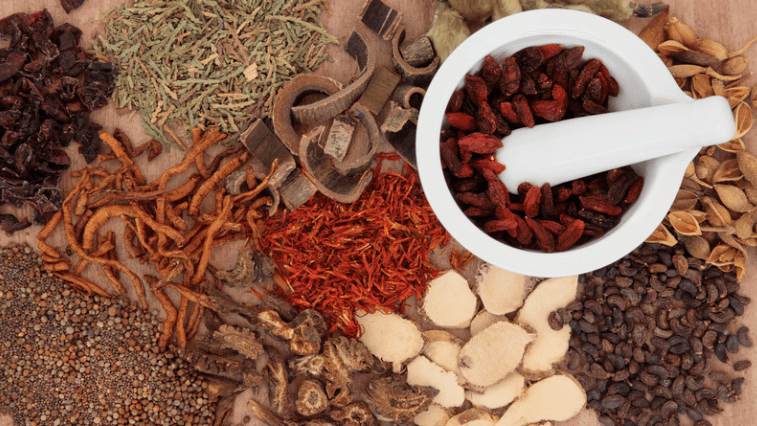
This energetic language does not remain abstract. It takes shape in everyday gestures, repeated with consistency. And above all, in the plants that grandmothers always keep within reach.
Jujube fruit (Da Zao) is one of these quiet presences. It appears in winter broths, in decoctions for tired young women, in soups prepared after menstruation. When a granddaughter seems pale or irritable, the grandmother doesn't announce a diagnosis: she simply adds a few more jujubes. For her, tonifying the Blood is not a theoretical formula, but an attentive adjustment.
Goji berries (Gou Qi Zi) often go into the family soup. Nourishing Blood and Yin, supporting vitality, preserving eyesight: all this is not always said. It is done. The grandmother knows that feminine energy does not recover in a day; it is cultivated through continuity.
Ginger (Gan Jiang) is called on as soon as the cold creeps in. During menstruation, after childbirth, in damp seasons, it becomes an essential ally. "You need to warm up," she says. Because for her, cold is not just a sensation: it can slow circulation, weaken the centre and disturb feminine balance. Warming is protecting.
Motherwort (Yi Mu Cao) supports feminine fluidity. Its Chinese name carries this intimate link with motherhood: "the herb that benefits the mother". Grandmothers knew its special relationship with Blood and the cycle. They did not use it systematically, but knew how to include it when the feminine rhythm seemed less fluid, more irregular or more uncomfortable.
As for ginseng (Ren Shen), a precious root associated with vitality, it comes in when energy needs support without being rushed. Grandmothers use it during a more demanding period or a change of season, to strengthen Qi and preserve endurance.
These plants were not used only when there was a problem: they were part of everyday life.
Gestures, as much as plants

Passing things on is not limited to ingredients. It often starts with a simple gesture: a hot cup handed from one generation to the next. A few jujubes, a little ginger, sometimes goji. The grandmother didn't talk theory. She simply said: "Drink this, it will do you good." This infusion already embodied an understanding of the female body: supporting the Blood, preserving warmth, accompanying the cycle.
But care doesn't stop at the cup.
Going to bed earlier is part of the same logic: at night, Blood returns to the Liver to regenerate, and respecting this rhythm becomes a preventive act. After childbirth, gradually restoring warmth and sparing energy protects future balance. Adapting diet to the seasons extends this attention: spring calls for fluidity, winter calls for protection.
These gestures are not isolated traditions. They rest on a coherent view of the body as a dynamic system, sensitive to cycles and to the environment. Grandmothers observed the complexion (a reflection of Blood), the appetite (a reflection of the Spleen), the mood (a reflection of Qi circulation). They read the signs before stepping in. Their knowledge does not impose itself. It follows the continuity of a rhythm, that of a living female body, always in motion.
Women, keepers of a living knowledge

This knowledge has not always been recognised as such. The great treatises were written by masters. But the continuity of care played out elsewhere: in kitchens, in repeated gestures, in the attention paid to women's cycles.
Grandmothers may not have signed the founding works. Yet they ensured the practical transmission of these principles. They observed, adjusted and adapted to the seasons and temperaments. Their knowledge is not expressed in abstract concepts. It showed itself through constancy.
Through a simple cup of infusion, a shared soup, a whispered piece of advice, a whole vision of the female body was handed down: a cyclical body, sensitive to the seasons, powerful but demanding respect and continuity.
These plants passed down from generation to generation are not just ingredients. They carry a memory. And this memory lives on every time a woman chooses to listen to her rhythm rather than force it.
