
In women, the menstrual cycle, also called the female hormonal cycle, begins at puberty and ends at the menopause. It corresponds to all the physiological phenomena that prepare a woman’s body for a “potential” pregnancy.
This cycle generally lasts about 28 days, but it can vary from one woman to another: it may be longer or shorter and, unfortunately, is not always regular. As long as fertilisation does not occur, the cycle starts again every month!
A physiological mechanism of the female body, the menstrual cycle is a marvel of complexity, with its emotional ups and downs!
We explain the complex sequence of the menstrual cycle from the point of view of traditional Chinese medicine.
The menstrual cycle
The menstrual cycle is essentially divided into three periods: the follicular phase, the ovulatory phase and the luteal phase. Four hormones are involved during these periods: luteinising hormone (LH), follicle-stimulating hormone (FSH), progesterone and oestrogen.
These three phases are:
-
The follicular phase, also called the proliferative phase, corresponds to the “maturation” of the egg and begins on the first day of the period. During this phase, follicle-stimulating hormone (FSH) stimulates the growth of a number of follicles. A single dominant follicle is eventually selected, and only one egg is brought to maturity. In addition, the hormone oestrogen produced by the follicle regenerates the lining of the uterus (endometrium). In general, the follicular phase lasts 13 to 14 days, but its length varies greatly from one woman to another, since it depends on the length of the cycle.
-
The second phase is the ovulatory phase. As its name suggests, it corresponds to ovulation: LH and FSH levels rise, causing one of the follicles to burst and release the egg. This phase generally occurs two weeks before the end of the cycle. It is, of course, the ideal time to conceive.
It should be noted that ovulation is sometimes not considered a phase in its own right, as some include it in the follicular phase.
- Finally, the luteal phase: this is the last phase of the menstrual cycle. It comes just after ovulation and lasts 14 days. The ruptured follicle closes up and forms the corpus luteum, a temporary cellular structure that produces oestrogen as well as a large amount of progesterone. If the egg is not fertilised, the corpus luteum degenerates after 14 days and oestrogen and progesterone levels fall, bringing on the onset of the period, which marks the start of a new cycle.
If, on the other hand, the egg is fertilised, the corpus luteum persists: the progesterone it secretes helps to prepare the “nest” (endometrium) that will receive the embryo.
Chinese medicine and the menstrual cycle
In traditional Chinese medicine, particular attention is paid to women’s health. TCM takes an energetic approach to the menstrual cycle and considers that it is made up of five phases.
The balance of the menstrual cycle is influenced by the quality and quantity of Qi and Blood, as well as by Yin and Yang. It is also directly linked to certain “organs”, or should we rather say “systems”, such as the Spleen and the Liver, but above all to the Bao gong.
The Uterus in Chinese medicine
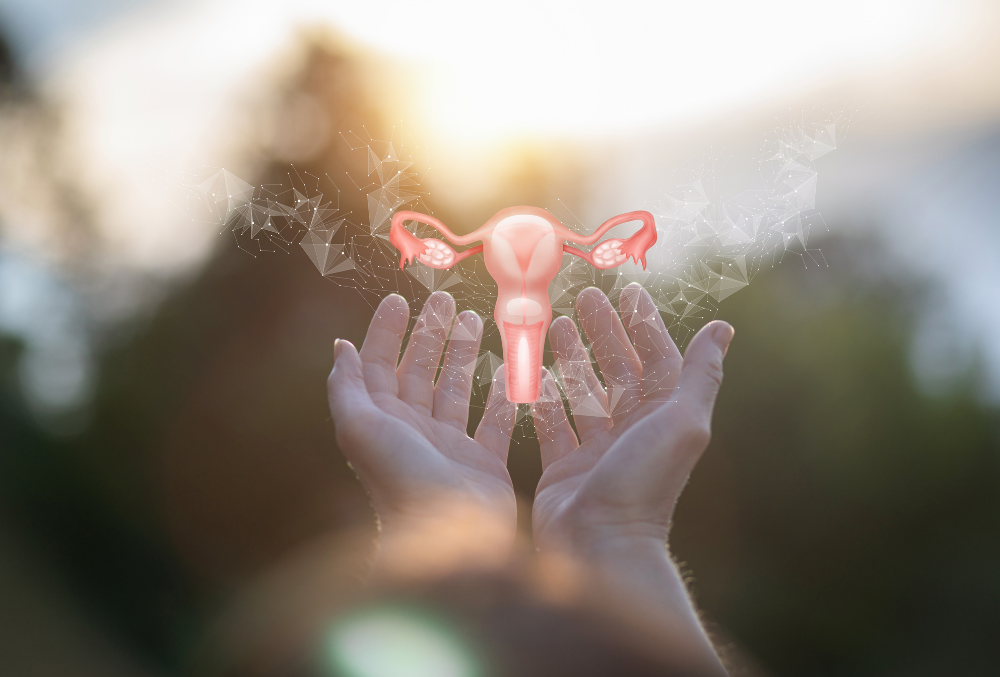
The Uterus, or Bao gong in Chinese (which means “the palace of the child”), is the system that governs menstruation, reproduction, fertility, pregnancy and childbirth.
In TCM, the Uterus is not considered an organ (as it is in Western medicine) but rather a system encompassing the whole female reproductive apparatus (fallopian tubes, ovaries). Its proper functioning is essential to women’s health, and it depends on several organs:
• The Spleen: the system responsible for producing Blood, the Spleen keeps the Blood in the vessels. Spleen deficiency affects Blood production and consequently has a heavy impact on the cycle: when the Spleen is out of balance, periods are scanty, or even absent in some cases (a weakened Spleen can lead to amenorrhoea). The proper functioning of the Spleen is therefore essential to the health of the Uterus, since it nourishes it.
• The Liver: a healthy Liver (which moves Qi and Blood in TCM) is essential for the Uterus to function properly. When Liver Qi stagnates, Blood stasis appears and affects the functioning of the Uterus: women with a failing Liver therefore generally experience dysmenorrhoea (period pain) or irregular periods.
• The Heart: it governs the Blood and is linked to the Uterus by the Bao Mai (Uterus meridian). Heart Blood and Qi take part in producing menstruation; consequently, Heart Blood deficiency affects the smooth running of the period and can lead to amenorrhoea.
• The Stomach: the Uterus is also linked to the Stomach by the Chong Mai, a meridian that ensures the Uterus is properly nourished with Blood. The Stomach transforms the Jing of food in order to nourish the Jing and Qi of the Kidneys. The nausea that some women may suffer during their period is therefore generally caused by an imbalance in the Stomach.
The five phases of the menstrual cycle
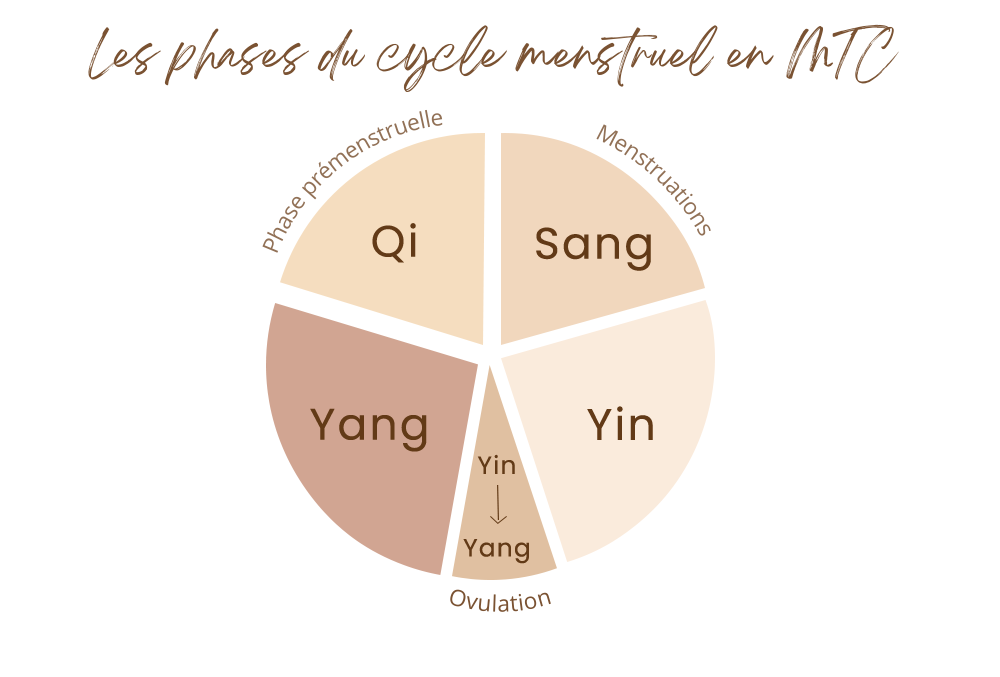
In traditional Chinese medicine, the menstrual cycle has five phases:
The Blood phase – the period
In Chinese medicine, the function of Blood (Xue) is to nourish the body’s tissues by carrying the Essences to the organs, and to moisten and warm the body. Essential to the smooth running of the menstrual cycle, it plays a key role in maintaining healthy periods.
The Blood phase begins on the first day of the period: the Blood stored in the Chong mai, also called the “Sea of Blood”, gradually empties. This phase is very important, since it is said that the way it is experienced will influence the rest of the cycle. That is why certain habits can be adopted to go through your period serenely.
In China, it is said to be important to avoid the cold during your period. Chinese dietetics recommends choosing so-called “warming” foods, since they help the Spleen to produce Blood. So favour foods such as fish, eggs, oranges, cherries, red grapes and raspberries.
What is more, intense physical exercise is strongly discouraged during the Blood phase. After major physical effort, the body draws on the Blood to nourish the muscles and exhausts its energy. As the menstrual period favours “Blood deficiency”, it is better to avoid depleting the Blood. Energy exercises such as Tai chi or Qi gong, on the other hand, are highly recommended, since they help to stimulate Blood circulation.
The Yin phase
It begins just after the end of the period and ends one day before ovulation. During this time, Yin rises gradually until it reaches its peak. The body then has to replenish the Blood. Qi mobilises the Blood to carry it up to the upper body and to nourish the Chong Mai meridian.
It is therefore essential to nourish Kidney Yin, the Blood and the Essences. During this phase, it is advisable to set aside “stimulating” foods such as caffeine, alcohol, sugar and strong spices, which threaten to weaken the Yin.
It is worth pointing out that the Blood phase and the Yin phase in a way “correspond” to the follicular phase in Western medicine and are sometimes considered a single phase in TCM. Likewise, the Yang phase and the Qi phase can be compared to the luteal phase.
Yin turns into Yang
After reaching its peak, Yin gives way to Yang: this is the moment of ovulation. Often associated with heat, Yang shows itself precisely through a rise in body temperature.
During this phase of the cycle, physical exercise is recommended, since it ensures the smooth circulation of Qi.
The Yang phase
This phase comes just after ovulation. As mentioned above, Yang warms the body, so it is no surprise that basal body temperature stays high until the start of the period.
This phase is dominated by Kidney Yang and Spleen Qi. An energy insufficiency at this level can therefore result in an abnormally short luteal phase (Yang phase + Qi phase) (a short luteal phase can sometimes point to difficulty conceiving or to miscarriage).
In the case of Spleen Qi deficiency, symptoms such as fatigue, loss of appetite and loose stools may be noticed. In the case of Kidney Yang deficiency, symptoms such as waking in the night, abnormal leucorrhoea (vaginal discharge) or reduced libido will be observed…
During this phase, it is recommended to avoid stimulants such as alcohol or coffee.
The Qi phase – the premenstrual period
The Qi phase occurs when the egg has not been fertilised. This phase corresponds to the premenstrual period: it lasts between 2 and 7 days. Liver Qi transforms Yang into Yin.
During this phase, it is important for Qi and Blood to flow freely through the body to avoid blockages and stasis. It is also necessary to take care of the Liver’s energy, since imbalances can give rise to all sorts of disturbances (commonly known as premenstrual syndrome: abdominal cramps, irritability, anxiety, aches, mood swings, weight gain…).
To get through this period full of changes, which some women can find difficult to manage, getting enough rest and listening to your body are essential.
The phases of the menstrual cycle undeniably set the rhythm of women’s daily lives. It is therefore important to understand and prepare for the different phases in order to go through the menstrual period in the best possible way.