
At the heart of traditional Chinese medicine, Qi (pronounced “chee”) is a basic notion for understanding the foundations of this medicine.
Often translated as "vital Energy” or “the vital Breath”, Qi is a creative force that animates the universe and every form of life.
What is Qi? What are its different forms and their functions? What are the disorders of Qi and how can you tonify it?
What is Qi?

One of the Three Treasures of traditional Chinese medicine, alongside Shen (the Spirit) and Jing (the Essence), Qi rests on a continuum between the individual and their environment. It creates, shapes and animates the universe and every form of life, and the proper functioning of the organs depends on its movement. Our health is built on its balance!
The circulation of Qi is affected by the change of seasons, emotions, a poor diet, overwork or torments of the mind; these factors lie behind energy imbalances.
So, to enjoy physical and mental fitness, Qi must flow freely through the human body, carried by the meridians that stream through our physical envelope.
The different forms of Qi
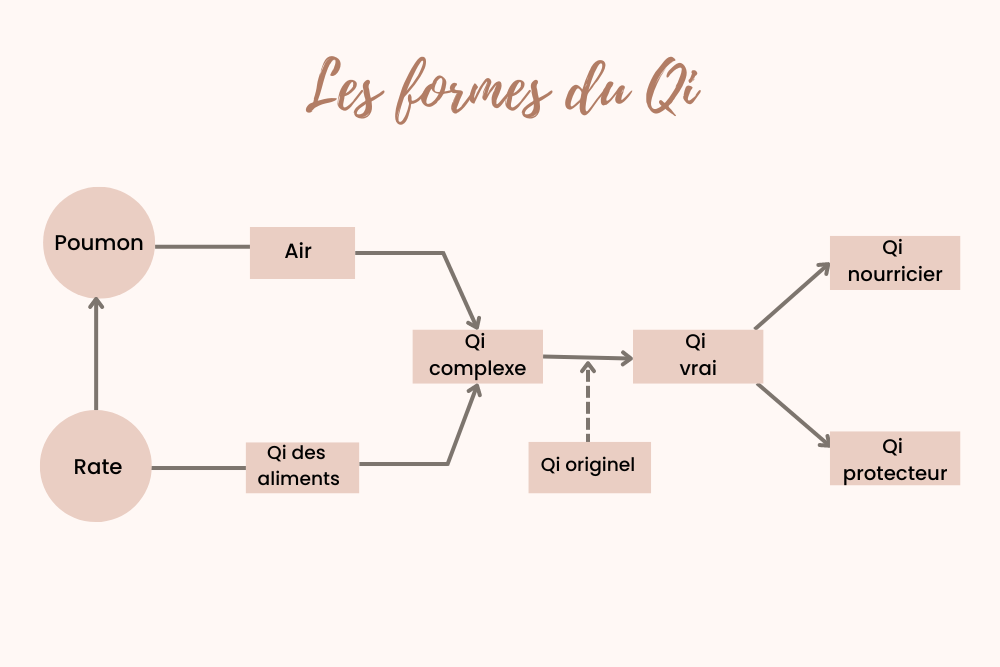
There are several forms of Qi:
- Food Qi
- Complex Qi
- True Qi
- Protective Qi
- Nourishing Qi
- Original Qi
A closer look at the role of each form of Qi:
Food Qi (Gu Qi)
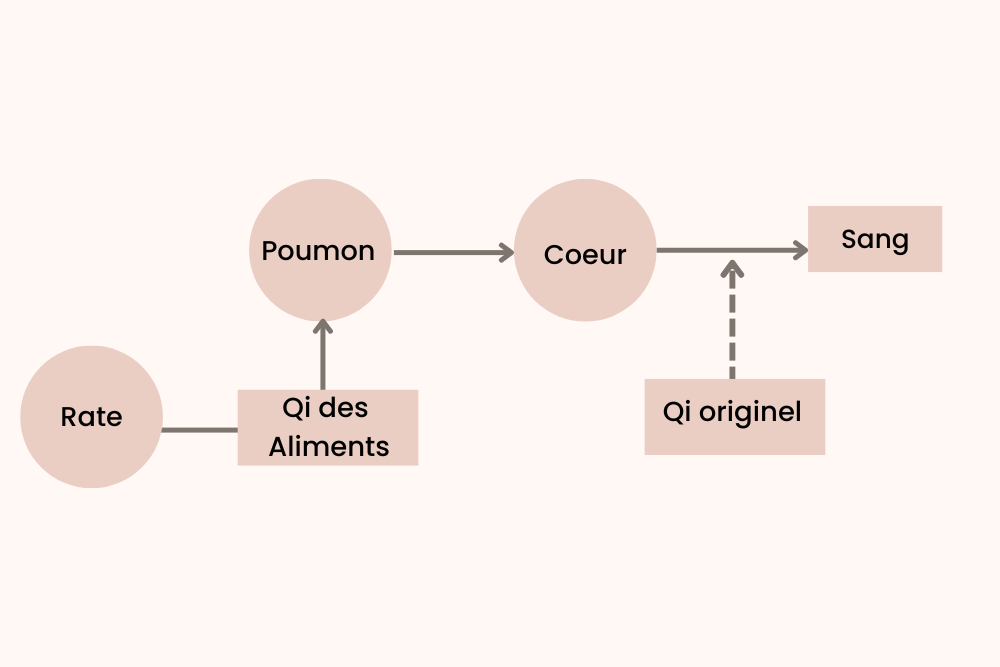
First, food reaches the Stomach, then is transformed into Food Qi by the Spleen. Next, Gu Qi rises to the chest, more precisely to the Heart, where it is transformed into Blood. This is the first phase of the transformation of Qi.
As we have already pointed out, the source of Food Qi is food, which is why traditional Chinese medicine stresses the importance of choosing a balanced diet that suits you energetically.
Complex Qi ( Zong Qi)
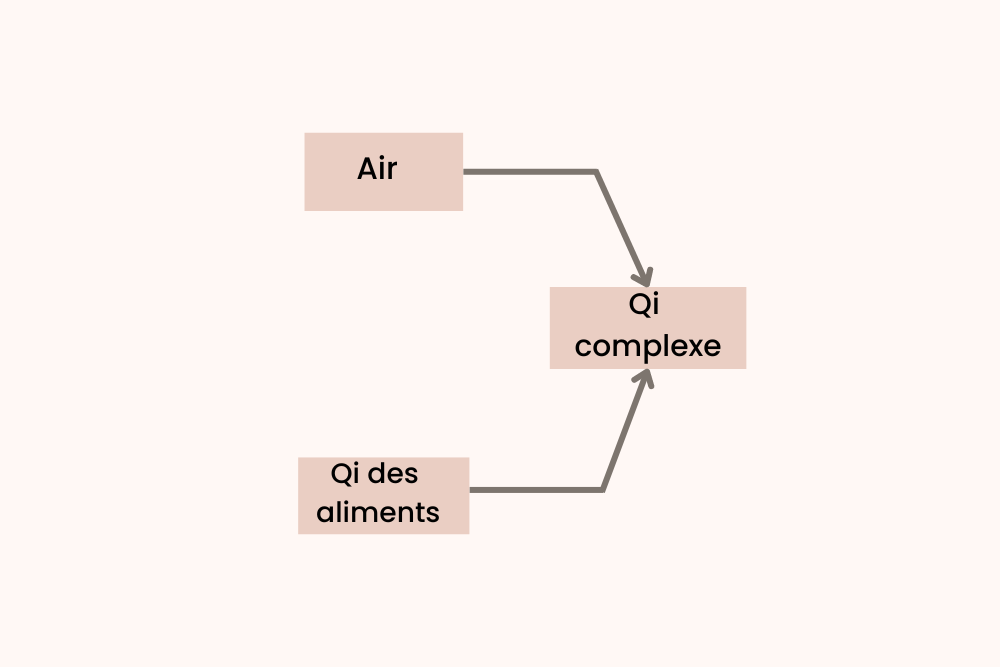
Also translated as “ancestral Qi” or “genetic Qi”, Zong Qi comes from the interaction between Food Qi and air. Indeed, the Spleen sends Food Qi to the Lung, where, combined with air, it is transformed into Complex Qi.
Complex Qi has several functions, but it mainly influences the Lung and the Heart. It nourishes these two organs, and assists the Lung in its function of governing Qi and the Heart in its function of governing Blood and the blood vessels.
In addition, it controls speech and the strength of the voice and helps regulate breathing.
True Qi ( Zhen Qi)
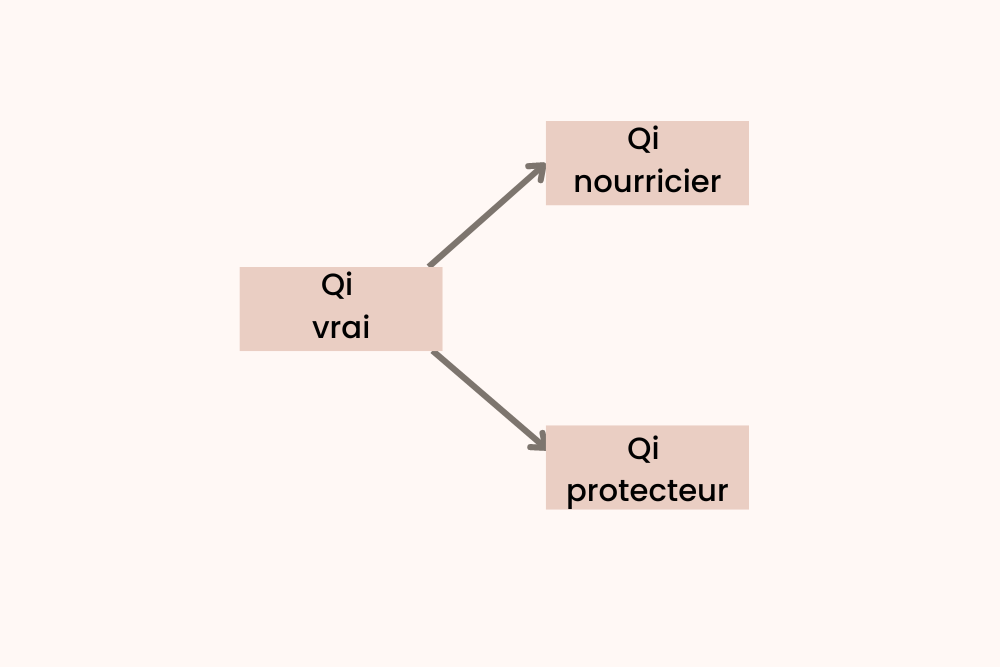
Also called "genuine Qi", True Qi is the last phase of the transformation of Qi: it is the Qi that circulates in the meridians to nourish the organs.
Genuine Qi comes from Complex Qi; more precisely, it originates in the Qi of the Lung, and it takes two forms: Nourishing Qi and Protective Qi.
Nourishing Qi (Ying Qi)
Translated as “nourishing Qi” or “ nutritive Qi”, it nourishes, as its name suggests, the organs and the whole body. Closely linked to Blood, it circulates in the meridians as well as in the blood vessels.
Protective Qi (Wei Qi)
The other form of True Qi is defensive energy, or Protective Qi. The role of Wei Qi is to protect the body from pathogenic energies.
During the day, it circulates along the meridians to warm and nourish the skin and muscles. At night, it goes deep into the Yin organs to ensure restorative sleep.
Original Qi (Yuan Qi)
Closely linked to the Essence (Jing), Original Qi originates in the Kidney. It is a refined, dynamic form of Jing (the Essence) that encompasses Original Yin (Yuan Yin) and Original Yang (Yuan Yang): Original Qi is therefore the foundation of all the Yin and Yang energies of the body.
This essential energy plays important roles in the body. First, Yuan Qi is known to stimulate the activity of the organs.
It also takes part in the transformation of Complex Qi into True Qi and in the transformation of Food Qi into Blood.
Disorders of Qi
Qi can be affected by various factors that cause either a deficiency or a stagnation and, as a result, bring on illness.
Qi deficiency
Insufficient Qi can be linked to various factors such as a poor diet (bad eating habits and food that does not suit you energetically), overwork, and so on. Generally, the Qi of the Stomach, the Spleen and the Lung are the most exposed to this deficiency.
Qi stagnation
This occurs when the circulation of Qi is blocked. Common causes of Qi stagnation include pathogenic emotions, trauma, stress and lack of physical activity.
How can you tonify your Qi?

To strengthen your vital Energy, traditional Chinese medicine offers several natural solutions.
First, there are many plants reputed for their tonifying power:
-
Huang Qi (Astragalus root): Classified in the Chinese pharmacopoeia among the herbs that tonify Qi, Huang Qi enters the Spleen and Lung meridians to tonify the Qi of the Middle Burner. In addition, it tonifies Original Qi (Yuan Qi) and generates Blood and fluids.
-
Ren shen (Ginseng root): This plant, very widely used in Chinese medicine, is reputed to be the greatest Qi tonic. Ginseng root is mainly used to strengthen Wei Qi (defensive energy) and increase Energy.
Besides medicinal plants, there are other ways to tonify Qi. For example, you can increase your Qi through food. Chinese dietetics recommends in particular eating foods with a neutral nature and a sweet flavour. Choose foods such as honey, eggs, sweetcorn or broccoli. And of course, as we like to remind you, it is all a question of balance!
Finally, traditional Chinese medicine advises practising energy exercises such as Tai Chi or Qi gong to preserve your energy.
Essential to our balance, Qi is the key to our fulfilment. Widely associated with spirituality, this notion reveals mysteries about our health and opens us up to the holistic and exceptional approach that traditional Chinese medicine takes to our health.

