Stress: why does it end up affecting the whole body? The Chinese medicine perspective

Stress never stays in your head
We often talk about stress as a mental state: too many thoughts, constant pressure, a mental load that is hard to manage...
But in reality, it doesn't stay only in the mind. It also settles in the body: lighter sleep, fatigue that won't go away, upset digestion, tension in the chest or neck, more frequent irritability, sometimes even palpitations... So many subtle signals showing that the body is already reacting.
What we call "stress" corresponds to a situation in which the body has to adapt to a pressure it can no longer fully regulate, especially when that pressure becomes hard to anticipate or control[1].
How stress settles into the body

Stress doesn't always strike suddenly. It often sets in gradually, almost silently.
Faced with a demand, the body springs into action: attention focuses, the heart rate speeds up, muscles tense, energy is mobilised. This reaction is natural; it allows us to adapt.
But when this phase no longer fully subsides, the balance shifts. The body stays on alert, without any real recovery. Little by little, this state becomes part of everyday functioning: sleep becomes lighter, digestion is disrupted, fatigue sets in, emotions become more unstable[2].
It is no longer just a one-off reaction, but a state that takes hold.
The Chinese medicine reading: understanding stress differently
Whereas modern medicine describes stress in terms of hormones, the nervous system or neurotransmitters, Chinese medicine offers another reading. It does not separate body, mind and emotions. Above all, it seeks to understand how prolonged pressure disrupts the internal balance.
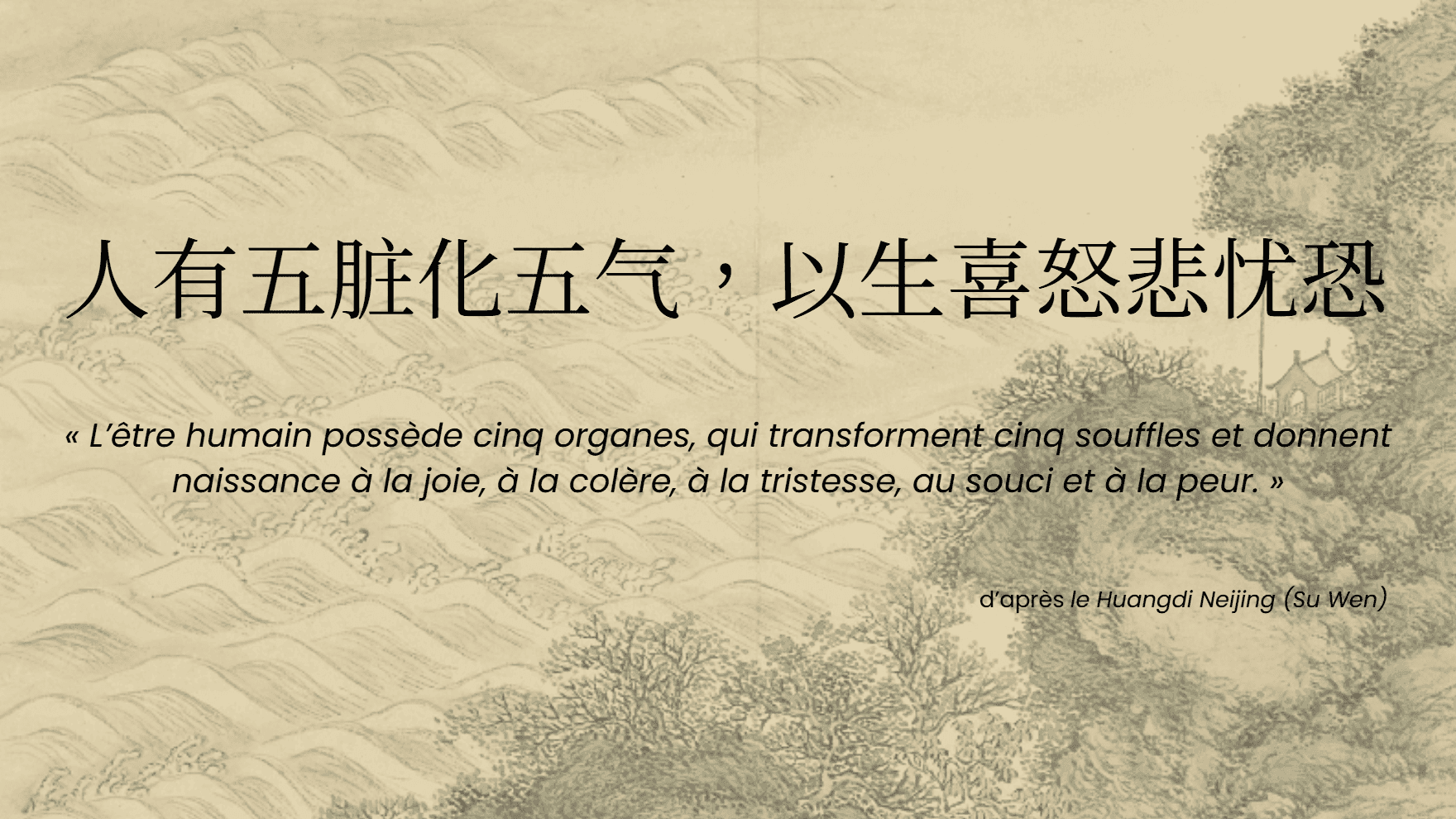
In the Huangdi Neijing (黄帝内经), one of the founding texts of Chinese medicine, we read: "Human beings have five organs, which transform five breaths and give rise to joy, anger, sadness, worry and fear."
In other words, emotions are not seen as mere isolated psychological states. They are also the visible expression of the body's internal activity.
This means that when certain tensions or emotional states last too long, they in turn end up disrupting the functioning of the body.
When stress disrupts circulation and the body's major functions
From this perspective, stress acts first and foremost as a constraint that hinders smooth internal circulation.
In Chinese medicine, as long as Qi flows harmoniously, the body adjusts, the mind stays clearer and emotions flow more easily. When this circulation becomes blocked or disordered, the first signs appear: inner tension, a feeling of oppression, frequent sighing, more sensitive digestion, restlessness or, on the contrary, exhaustion.
Recent Chinese medicine sources describe this logic as a progressive imbalance that can affect several of the body's major functions, in particular those linked to the Liver, Heart, Spleen and Kidney[3].
The Liver: the function that manages circulation and tension
In Chinese medicine, the Liver is the function most closely linked to stress reactions. It refers above all to a function of regulation, circulation and adaptation. That is why it comes up so often in stress-related disorders.
When this function is harmonious, tensions release more easily, emotions flow and the body keeps a certain suppleness. But when stress becomes prolonged, this dynamic seizes up. The circulation of Qi slows, becomes blocked or irregular. This can show up as irritability, a feeling of being tense or "stuck", sighing, a tight chest, upset digestion or mood swings.
In contemporary Chinese medicine texts, this mechanism often appears in the form of stagnation or blockage. It is very often the first level of stress-related imbalance.
The Heart: the function of inner calm and Shen
In Chinese medicine, the Heart is closely linked to Shen, meaning mental activity, the quality of presence, inner clarity and sleep. When we say that "the Heart is troubled", this does not simply mean a strong emotion: it refers to a state in which inner rest becomes more difficult.
When stress sets in, this function can be disrupted: thoughts become more intrusive, sleep becomes fragile, mental restlessness increases and anxiety is felt more easily. It is often at this stage that stress starts to be perceived as "mental", when in reality it already reflects a more general imbalance of the body. Chinese clinical studies and guidelines on anxiety regularly highlight patterns such as Shen disturbance, Heart restlessness or the joint involvement of the Heart and other internal functions.

The Spleen: the function of transformation, energy and rumination
In Chinese thinking, the Spleen is linked to digestion, to the transformation of food into energy, but also to the stability of thought. That is why it plays a central role in what we might call the stress that "wears you down".
When this function weakens, we may see more marked fatigue, a tendency to overthink, ruminate and worry, as well as slower or more irregular digestion. It is no coincidence that some people, under stress, immediately feel exhausted, more sensitive after meals, or unable to quieten their mind. In Chinese medicine, this kind of picture often points to a Spleen weakness or a joint involvement of the Heart and Spleen.
The Kidney: the function of foundation, recovery and reserve
In Chinese thought, the Kidney represents something deeper: the reserve, the foundation, the capacity to recover. As long as this function holds firm, the body can still compensate. But when stress lasts too long, recovery becomes poorer, sleep is no longer truly restorative, and fatigue becomes deeper and more diffuse.
This is often when you feel that stress no longer simply passes with rest or a few calmer days. It seems to be "etched" more deeply into the body. Modern Chinese classifications describe this through patterns such as imbalance between the Heart and Kidney, or certain more entrenched forms of exhaustion.
From blockage to restlessness, then to exhaustion
What Chinese medicine brings that is particularly interesting is that it does not see stress as a single category. It reads it as a process that evolves.
At first, stress may mainly block: circulation works less well, tension rises, the body tenses up.
Then it can unbalance: sleep becomes more fragile, the mind more restless, digestion more sensitive, mood more unstable.
Finally, when it goes on, it can exhaust: recovery declines, fatigue becomes deeper, the body can no longer compensate so easily.
This progression matches what contemporary Chinese approaches describe: stagnation, restlessness, exhaustion, imbalance between several of the body's functions.
Regaining balance: a change of perspective

Understanding stress is a first step. But at some point, the question becomes simpler: where are you today? Because stress is not only lived in our thoughts. It is part of everyday life: in our rhythm, in our fatigue, in the way the body reacts, sometimes without us even realising it.
Rather than trying to control everything, it can help to start there: observe, take stock and see what can already help. Assessing your stress level, understanding what your body needs today and exploring simple approaches to regain more stability: that is what we offer you in the next article.
What is your stress level? 6 approaches inspired by Chinese medicine to regain a more stable balance
[1] Mustafa Murtaza, Illzam EM., Muniandy RK., Hashmi MI., Sharifa AM. and Nang MK., Causes and Prevention of Occupational Stress. IOSR Journal of Dental and Medical Sciences. 2015 Nov;14(11):98–104. doi:10.9790/0853-1411898104.
[2] Chrousos George P., Stress and disorders of the stress system. Nature Reviews Endocrinology. 2009 Jul;5:374–381. doi:10.1038/nrendo.2009.106.
[3] Chen Zhaobin, Zhang Bo, Liu Xiumin and Huang Shuming, Research progress on the pathophysiological mechanisms of anxiety disorders. Tianjin Journal of Traditional Chinese Medicine. 2018 Apr;35(4):316–320. doi:10.11656/j.issn.1672-1519.2018.04.21.