- The Zangfu of Chinese medicine
- The Heart according to Chinese energetics
- Its role in the body
- The Small Intestine: the Heart’s shield
- Factors that threaten the Heart’s balance
- The Chinese pharmacopoeia takes care of our Heart


The Heart (Xīn): the organ of summer in Traditional Chinese Medicine

Although it may not be quite noticeable yet, summer is already upon us! According to the Chinese lunisolar calendar, summer began on 6 May and will end on 20 July, giving way to the inter-season. This is therefore the perfect opportunity to take a closer look at the one Chinese texts nickname the “Emperor”: the Heart.
Traditional Chinese Medicine (TCM) holds that particular attention should be paid to the Heart during the summer season. The Heart is associated with summer, but also with the colour red, Fire, the South, joy, growth…
Discover the role of the Heart in Chinese medicine and how to take care of it with the plants of its pharmacopoeia.
The Zangfu of Chinese medicine
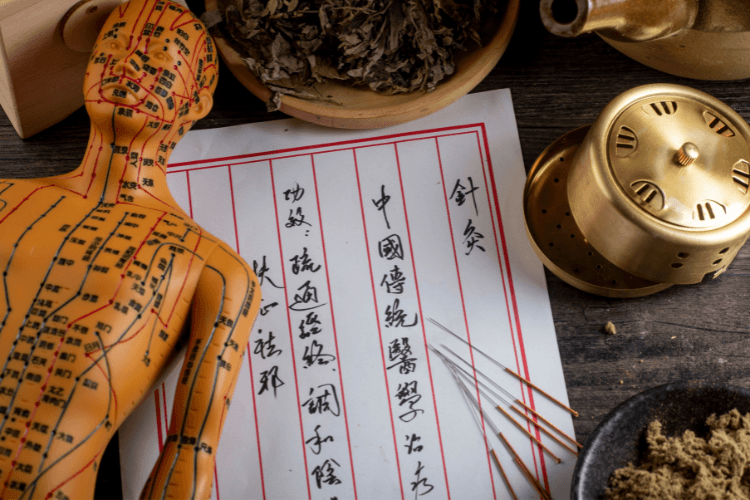
In Traditional Chinese Medicine, we speak of the Viscera (Zangfu) to refer to the “solid” Organs (Zang) and the “hollow” Bowels (Fu). They are complementary: the Zang are Yin and the Fu are Yang.
The Zang are considered the reservoirs of the essential substances (Qi, Blood, Fluids…): they are responsible for regulating and storing them, as well as for producing and distributing Vital Energy throughout the body. They include the Heart, the Lung, the Spleen, the Liver and the Kidneys.
The Fu mainly have a role in digestion and elimination. They are temporary reservoirs for substances that will soon be used or eliminated by the body. They include the Small Intestine, the Large Intestine, the Gallbladder, the Stomach, the Bladder and the Triple Burner.
Each Zang is paired with a Fu. The Heart, called xīn in Chinese, is one of the Zang, so by extension it is coupled with a Fu, in this case the Small Intestine.
Just like conventional medicine, Chinese medicine regards the Heart as an organ essential to the proper functioning of the body. The functions it attributes to it, however, are completely different.
The Heart according to Chinese energetics
The Heart is a whole system within the body. It centralises physical and psychological functions, which is why it is said to be the Emperor of the body and the Mind, and the Master of the organs.
Its role in the body

Fundamental to the body’s activity, the Heart’s main role is to govern the Blood and to house the Shen. But these are not its only functions. In Chinese energetics, the Heart is responsible for:
-
the production and circulation of Blood: the Spleen transforms the food we eat in order to extract its Qi. It then sends this food Qi to the Heart to be made into Blood. A healthy Heart allows sufficient Blood of good quality to be produced. Conversely, Heart Blood Deficiency is often associated with an energy imbalance that can affect mental and emotional vitality. According to this approach, it can show up as a feeling of fatigue, disturbed sleep or cyclical discomfort in women.
-
control of the Vessels: the Heart is the master of the blood Vessels. If Heart Qi is fluid and sufficient, the Vessels will be in good condition and the pulse regular.
-
regulating perspiration: by overseeing the circulation of Blood, the Heart helps to regulate body temperature. Consequently, experiencing excessive sweating can be a sign of a weakened Heart.
-
housing the Shen: the Shen (also called “the Mind”) is one of the Three Treasures of Chinese medicine. This substance lodged in the Heart encompasses mental, emotional and spiritual functions. A healthy Heart is therefore essential for emotional and psychological stability. When the Heart is dysfunctional or weakened, it can no longer house the Shen properly. As a result, the Shen becomes agitated and scattered, causing anxiety, stress, mental agitation, depression or sleep disorders.
Chinese medicine also holds that the state of the Heart shows in the complexion. A bright, fresh complexion indicates good heart health, while a pale, dull complexion is generally a sign of Blood deficiency or Blood Stagnation.
The Small Intestine: the Heart’s shield
The Small Intestine is recognised as having a sorting function. It receives food after it has passed through the Stomach and separates the Pure, which it passes on to the Spleen, from the Impure, which it sends to the Large Intestine and the Bladder to be eliminated from the body.

TCM also states that the Small Intestine has a role of discernment, that it is the “clarity of the Mind”. So, just as it does with food, the Small Intestine steps in to sort through the various options open to us when we are in doubt. It helps us see more clearly by selecting what is good and setting aside what is not, and thus protects the Heart from the emotional impact that bad decisions can have.
Factors that threaten the Heart’s balance
Heart Qi is an energy essential to the heart’s functions and to emotional and mental functions. It is therefore important for this energy to be abundant and to flow freely.
But how can you tell when the Heart is out of balance? When the Heart is weakened and its Qi is insufficient, signs such as palpitations, emotional disturbances, difficulty falling asleep or chest pain become noticeable.

Certain factors pose a danger to Heart Qi because they seriously threaten its balance, sometimes to the point of causing illness. These factors include:
-
Excessive emotions: emotions experienced to excess can harm the Heart. Moreover, the theory of the 7 emotions associates the Heart with joy. It is therefore normal to feel particularly joyful in summer; however, TCM recommends moderating this emotion to avoid damaging the Heart.
-
Mental overwork: excessive thinking or prolonged stress can exhaust Heart Qi.
-
An unbalanced diet: excessive consumption of spicy food and of fatty and hot foods should be avoided. To take care of the Heart, Chinese dietetics recommends foods that are cool in nature and sweet or bitter in flavour. In addition, red foods (red being the colour associated with the Heart and with summer) help to preserve the health of the Heart!
-
Excess Heat: when there is too much Heat in the body, it causes the body to become overactive and dry (evaporation of Fluids). In some cases it can turn into Fire, which has more serious consequences for health. The Heart is one of the organs most exposed to extreme Fire. So, to prevent excess Heat, it is advisable to drink green tea (reputed to disperse Heat and calm the Mind), eat foods that are cool in nature, avoid prolonged exposure to the sun, keep our emotions in check and get enough rest.
-
A lack of physical exercise: lack of physical activity threatens the health of the Heart because it encourages the stagnation of its Qi, affects blood circulation and contributes to increased stress and anxiety (and therefore leads to emotional disharmony).
In some cases, these factors that weaken the Heart can give rise to imbalances, generally related to Blood circulation and psycho-emotional health.
Taking care of the Heart is therefore essential to maintain good mental and physical health.
The Chinese pharmacopoeia takes care of our Heart
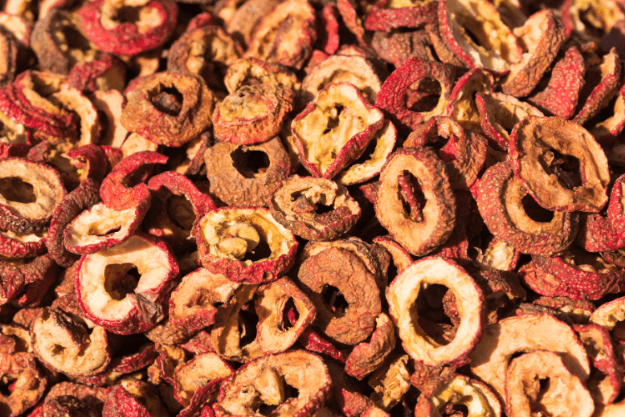
Shan zha (Crataegus pinnatifida): hawthorn fruit
In addition to the advice of Chinese dietetics and the general recommendations of TCM, there are the plants of the Chinese pharmacopoeia. The Chinese pharmacopoeia offers many natural solutions for taking care of the Heart.Among the most popular Chinese herbs for heart health are:
- Hawthorn fruit (Shan zha): The dried fruits of this plant, nicknamed the “heart plant”, are traditionally used to help regulate blood pressure, improve circulation and revitalise blood flow. Thanks to its influence on the heart, Shan zha is also recommended to soothe agitation and promote relaxation.
- Red sage (Dan Shen): red sage root is reputed to cool, stimulate and nourish the Blood, and to clear Heat. It also acts on the Shen to soothe it. It is therefore a major ally in taking care of the Heart.
- Jujube seeds (Suan zao ren): jujube seeds are traditionally used to nourish Heart Yin, calm the Shen (the mind) and support Liver Blood. They are particularly valued in situations of energy imbalance associated with inner restlessness, unstable mood or disturbed sleep.
- Five-flavour berries, or schisandra berries (Wu wei zi): reputed to be at once sweet, salty, bitter, pungent and sour, five-flavour berries tonify Qi, tranquillise the Mind and calm the Heart.

The Heart thus occupies a central place in Chinese medicine, on both the physical and the psycho-emotional level. Taking care of this organ is essential to maintaining good overall health. That is why Chinese medicine offers a set of principles and practices aimed at preserving the health of the Heart.
To get through the summer smoothly, choose an energetically appropriate diet, take regular physical exercise and learn to manage your stress and emotions. Finally, put your trust in the Chinese pharmacopoeia and use specific medicinal plants to tonify, nourish and balance the Heart.
