- The female body is not a territory to be corrected
- Autonomy and knowledge: reconnecting with the body's intelligence
- Understanding your energy in a linear world
- Modern stress and female balance
- Rituals: preserving your vitality without disconnecting from yourself


Women's rights & women's health: reclaiming sovereignty over your body

The female body is not a territory to be corrected
Women have won essential rights. The right to study, to work, to decide, to run their own lives. But at the heart of this conquest, a more intimate question remains: does this freedom really start from our deepest needs?
In a world that values performance, control and optimisation, women are often invited to prove that they can do everything: keep up the pace, stay efficient, be available, productive, consistent. Yet the female body is not linear. It is cyclical. It varies, fluctuates, and sometimes asks for rest, sometimes for support. Many women learn to claim their rights. But few learn to listen to the subtle signals of their own energy.
Reclaiming sovereignty over your body does not only mean deciding for yourself. It means hearing what the body is expressing (fatigue, tension, slowing down…) without treating it as an obstacle to overcome. Because freedom does not always mean doing more. Perhaps it begins with the ability to stop, to feel, to recognise your needs and to give them a legitimate place. And this kind of listening calls for a deeper change: reconnecting with the intelligence of the body.
Autonomy and knowledge: reconnecting with the body's intelligence
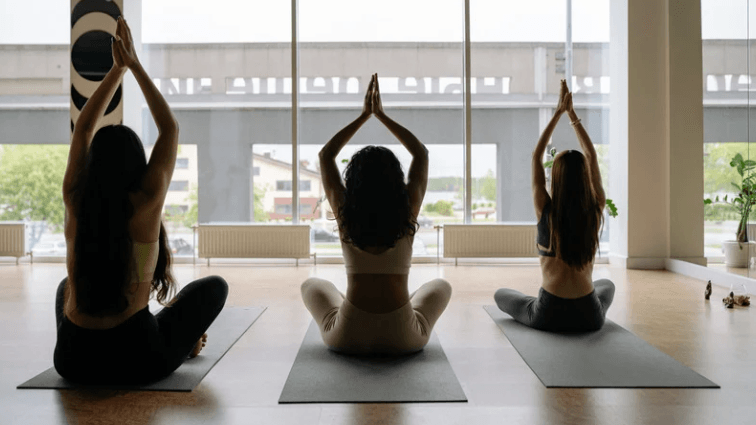
We often talk about autonomy as an outward conquest: being able to decide, choose and act without dependence. But there is a subtler autonomy: an inner autonomy. It begins when we stop seeing the body as a tool to be optimised and recognise it as a living system to be understood.
Many women live in a form of silent disconnection. They achieve, organise and move forward, while gradually drifting away from the signals their body sends: recurring fatigue, diffuse tension, unexplained irritability… According to TCM, these signs are not flaws to be corrected but messages. They show that the female body is neither stable nor constant: it is traversed by movements, the rise and fall of Blood, the circulation of Qi, the alternation of fullness and emptiness.
Learning to recognise these movements transforms your relationship with yourself: a slowdown becomes a phase, irritability becomes a sign of stagnation, exhaustion becomes a call to nourish rather than to force… This knowledge does not reduce freedom. It deepens it. Because a woman who understands how she works stops measuring herself only against external standards. She begins to adjust her rhythm consciously. But this adjustment often runs up against an environment that works by other rules.
Understanding your energy in a linear world

The world rests on a linear model: consistency, continuous productivity, steady performance, being efficient every day, emotionally stable, available without variation… but this model does not take into account the cyclical functioning of the female body.
In TCM, Qi circulates, transforms and fluctuates. Blood follows phases. Some periods call for momentum, others for recovery. Some call for circulating, others for nourishing. When this natural rhythm is ignored, tension sets in.
- We speed up when we should consolidate.
- We demand when we should support.
- We force when we should restore.
The gap between the inner rhythm and outer demands becomes a source of silent wear and tear. It is not a lack of willpower. It is an incompatibility of models.
Understanding your energy in this context then becomes an act of discernment: recognising that fatigue is not always a weakness, that variability is not instability, that the need to slow down is not a failure.
Freedom does not mean conforming perfectly to a linear rhythm. It means preserving your inner coherence in spite of it. And when this gap goes on, stress sets in.
Modern stress and female balance

Stress is not just a passing emotion. It can lead to a gradual stagnation of energy circulation. Mental load, multiple responsibilities, being permanently connected, the implicit pressure to be efficient all the time: all of this creates an underlying tension.
In TCM, prolonged stress acts mainly on the Liver. When this circulation becomes blocked, the female body is often the first to be affected:
- Irregular cycles
- Premenstrual tension
- Sleep problems
- Persistent fatigue despite rest
These are not individual failings. They are signals. Qi stagnation gradually disrupts the circulation of Blood. And since the female body has a close relationship with Blood, overall balance is weakened.
Here lies the paradox: the more a woman tries to stay in control, the more she risks reinforcing internal tension. Reclaiming sovereignty over your body then calls for a subtle change: not just managing stress, but restoring circulation. And that starts with concrete gestures.
Rituals: preserving your vitality without disconnecting from yourself
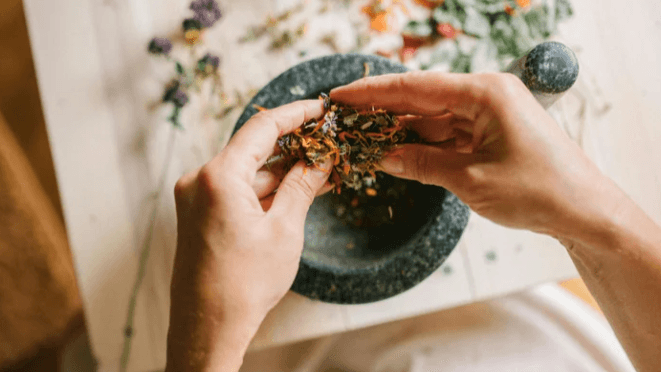
Reclaiming sovereignty over your body does not mean adding new obligations. It is about restoring coherence. In TCM, it is said that women "have Blood as their foundation and the Liver as their pivot". In other words, their vitality depends on what nourishes deeply and on what flows freely. This often starts on the plate, and in the cup.
Choosing foods that support rather than exhaust. Roots, vegetables, wholegrains. Fruit such as jujube or longan, known for nourishing Blood. Eating them in a broth, a gentle soup or as a hot infusion at the end of the day becomes a simple gesture of regulation.
Drinking an infusion of jujube and ginger before your period, for example, is not folklore. It is a way of preserving internal warmth and supporting circulation.
Movement also plays a part in this sovereignty. Walking, swimming, practising Qi gong or simply breathing deeply are not about performance. They get Qi flowing again when stress has tightened it.
Some periods call for more attention. During menstruation, Blood is in motion: avoiding cold, favouring warmth and limiting exhaustion support this natural process. After childbirth, the body has mobilised a great deal of Blood and Qi. It needs restoration, nourishing food and structured rest. At menopause, the gradual decline of Yin and Jing calls for gentleness and support rather than struggle. These moments are not fragilities. They are energetic transitions.
Sleep then becomes a pillar. "When we lie down, Blood returns to the Liver." Protecting the night and avoiding late nights can be supported by simple gestures: a warm foot bath before bed to promote circulation, a soothing infusion to calm the mind.
Because emotions play a central role. In TCM, the Liver regulates the free flow of Qi and is closely linked to the emotional sphere. Held-back tension ends up settling in the body. Supporting the Liver with plants such as goji berries, chrysanthemum or bupleurum root helps maintain this fluidity. Calming the mind with plants such as reishi or rosebuds also helps restore inner balance, and brings back a radiant complexion when energy flows freely.
When the pressure becomes more intense (mental overload, prolonged stress, broken nights), the body may need more structured support. Certain traditional formulas then follow on from this, helping to calm the mind while supporting energy without forcing it. Blends such as the Calm & Relaxation Formula (An Shen Wan) extend this logic: encouraging better-quality sleep, easing the feeling of overwork and restoring more harmonious circulation.

Even small gestures (massaging certain points, warming the lower belly, taking time for a mindful cup of infusion) can become silent reminders: the body is not an obstacle to be overcome. It is an ally to be accompanied.
These rituals do not aim for perfection. They restore continuity. And in this continuity perhaps lies the most concrete form of freedom: staying engaged with the world without abandoning yourself.

