Exploring the forms, and 1001 questions about herbal decoctions

The different forms offered by the Laboratory
Finely ground powder
- Pour the level scoops into a bottle, add boiling water and leave to infuse overnight.
- The next day, drink the infusion throughout the day.
Depending on the dosage, the Laboratory will provide a suitable measuring scoop. The capacity is indicated on the scoop. Some practitioners recommend it as a decoction, for external use or for brushing teeth. Consult your practitioner for precise instructions.
Finely ground powder for external use
- Place 2 tablespoons of powder in a small bowl, add 1 tablespoon of lukewarm water, mix vigorously, add another tablespoon of lukewarm water if necessary, and keep mixing until a thick paste forms.
- Heat in the microwave for 5 to 6 seconds. Make sure the temperature is not excessive, then apply directly to the painful area. It is best to apply it for 6 to 12 hours (4 hours minimum) overnight while you sleep.
It is recommended to carry out a skin test beforehand to detect any potential allergy before use.
Concentrated powder
- Pour the contents of 3 level scoops (morning and evening) into boiling water, mix well and drink half an hour before a meal or one hour after.
One level scoop = 1.5 g
Capsules
- Swallow 3 capsules morning and evening with a large glass of water half an hour before or one hour after meals.
One capsule = 0.5 g
Whole herbs
- Empty the contents of the sachet into your earthenware or ceramic pot, add cold water and leave to soak for 30 minutes. The water level should be 2 to 3 cm above the herbs, i.e. about the thickness of two fingers.
- Bring to the boil and cook for 5 minutes over a high heat. Then turn down to a low heat and leave to simmer for 30 minutes, partially covered.
- Strain and set aside the first liquid obtained.
- Pour in cold water again without soaking (i.e. the equivalent of 2–3 cm above the herbs, about the thickness of two fingers) and cook the same herbs a second time over a low heat for 30 minutes.
- Strain and mix the two preparations, then drink the decoction in two doses (morning and evening) 30 minutes before or 1 hour after meals.
Herbs in infusion bags (paper sachet) or crushed herbs (plastic sachet)
- Place one infusion bag of herbs or pour one dose of crushed herbs into a saucepan, add cold water and leave to soak for 20 minutes. The water level should be 2 to 3 cm above the herbs, the equivalent of about two fingers.
- Bring to the boil over a high heat, then turn down to a low heat and leave to simmer for 20 minutes. Carry out a second decoction with the same herbs for 20 minutes.
- Strain and mix the two preparations, then drink the decoction in two doses (morning and evening) 30 minutes before or 1 hour after meals
The amount of water should be adjusted according to the instructions on the label or your practitioner's recommendations.
Everything you need to know about decoction
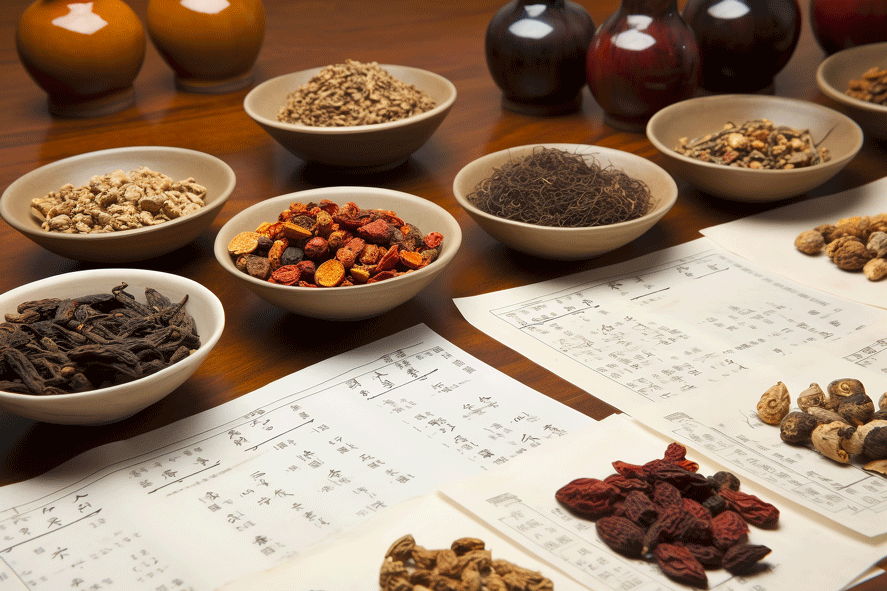
The process of decocting plants involves two types of change: on the one hand, the active ingredients are extracted and dissolved, and at the same time, the various active compounds present in the plant may also undergo chemical reactions. The decoction method is closely linked to the effectiveness of the decoction, so it is essential to understand clearly how decoction works.
1- Cleaning the herbs
Before decocting, it is generally not necessary to wash the herbs thoroughly. A quick rinse with water is enough for slightly dirty herbs. Avoid soaking them or rinsing them for a long time so as not to lose the soluble active ingredients, which could affect the effectiveness of your preparation.
2- Preparation equipment
It is best to choose a ceramic or clay pot for an even, good-quality decoction. However, clay pots can absorb odours and break, so enamel, stainless steel or glass pots are also good choices. Avoid copper, iron, aluminium or tin, as they could alter the properties of the herbs.
3- Soaking
This step prepares the extraction of the active ingredients. Before decocting, soak the herbs in clean, cold water, with the water level 2 to 3 cm above the herbs. Leave the herbs to stand for 30 min (for tonifying formulas, extend the time if necessary). Avoid boiling water, as it makes proteins and starch coagulate quickly, which would make it harder to extract the active ingredients and could affect effectiveness.
Tips: 2–3 cm is roughly the thickness of 2 fingers.
4- Decocting
When preparing herbs, it is recommended to decoct them twice. Start by bringing to the boil, then time the decoction from the moment the water boils. The first decoction lasts 20–25 min, the second 15–20 min. For detoxifying formulas, the first decoction lasts 10–15 min, followed by the second decoction for 10 min. For tonifying formulas, the first decoction takes 30–40 min and the second decoction 25–30 min. While decocting, stir gently to prevent boiling over or overcooking. Keep the lid on as much as possible. After decocting, strain everything immediately. For adults, keep 200–300 mL of liquid, and for children, 100–150 mL. If there is too much liquid, keep decocting to reduce it to the required amount before taking it. If the decoction accidentally burns or boils dry, it is recommended to stop using it, as this can produce toxic substances.
What's in your order: what you will receive
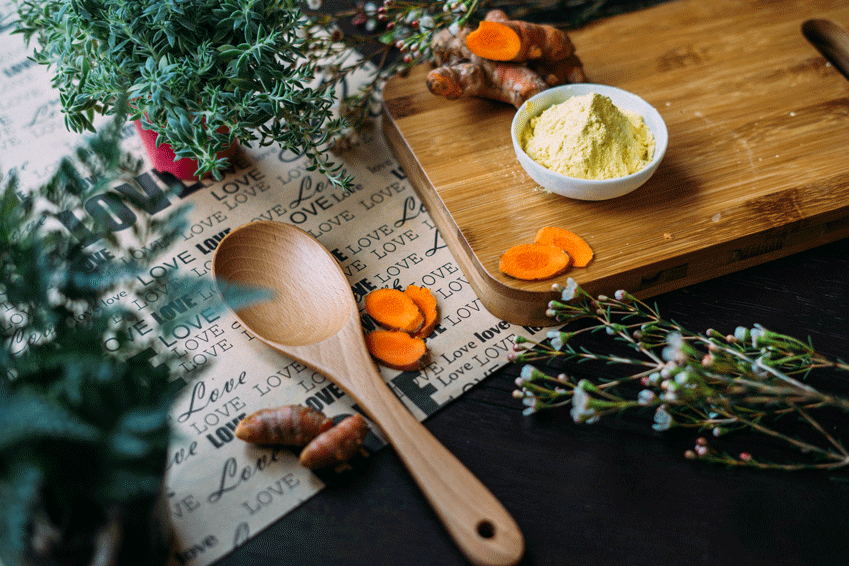
Long decoction: Hard substances such as dragon bone (Long gu), oyster shell (Mu li), gypsum (Shi gao), etc., are best decocted for 30 minutes before being added to the other ingredients.
Note: The herbs supplied by Calebasse Laboratoire are already finely ground.
Quick decoction: For aromatic herbs rich in volatile oils, such as peppermint (Bo he), Patchouli (Guang Huo Xiang), Sha ren (Amomum villosum) and cardamom seeds (Bai dou kou), add them to the almost-finished decoction and cook together for 2–3 min to preserve their benefits.
Herbs in an infusion bag: Some less dense herbs such as pollen, and small seeds such as Pu huang (Typha angustifolia), Ting li zi (Descurainia sophia), dodder seeds (Tu si zi), Perilla seeds (Zi su zi) etc., can float on the surface during decoction. Plantain seeds (Che qian zi), rich in starch or mucilage, may stick to the bottom of the pot. Hairy herbs such as Xuan fu hua (Inula japonica) or Loquat leaves (Pi pa ye) can irritate the throat. For these herbs, prepare them in an infusion bag during decoction.
Separate decoction: For rare herbs or those used in small quantities, such as ginseng and American ginseng, it is recommended to decoct them separately to preserve their benefits.
Taken mixed in: Some rare substances that dissolve poorly in water, such as donkey-hide gelatine (E jiao) and notoginseng flowers (San qi), are best taken as a fine powder added to the decoction. Others, such as powdered amber, fresh ginger juice (Sheng jiang) and Rehmannia root (Sheng di huang) juice, can also be taken with the decoction.
Note: The herbs mentioned are supplied directly as a fine powder by the Laboratory.
Infusion: For light substances to be taken in small quantities, such as chrysanthemum buds (Ju hua), saffron (Zang hong hua) and Malva nut(Pang da hai), infuse in a large cup of water and leave covered for 10–15 min before drinking.
Melting in a bain-marie: Avoid decocting substances such as gelatine, honey or malt sugar (Mai ya tang) with other ingredients, to prevent them from burning or sticking to the bottom of the pot. Dissolve them in a small amount of hot water in a bain-marie to liquefy them, then mix them with the rest of the decoction.
Simple dissolving: Substances such as sodium sulphate can also be dissolved in the decoction before taking it.
Taking your herbal preparation
After two decoctions, mix the liquids obtained and divide them into two equal doses. The dosage of decoctions varies: for adults, 300 mL split into two doses; for 12-year-old children, 200 mL; and for infants or young children (around 5 years old), 100 mL, all divided into two doses, morning and evening. How you take your decoction depends on the treatment and on how you respond to it.
In general, it is advisable to wait one hour after meals. Tonifying formulas are better absorbed on an empty stomach, while digestive formulas are best taken after meals to avoid irritation. Avoid draughts after formulas that eliminate Heat, and keep an eye on changes in body temperature. Formulas for urinary comfort are more effective on an empty stomach, as are dewormers taken in the morning. Observe the effects on the stools. Herbal teas for periods are often taken before menstruation. Calm and Relaxation-type formulas should be taken before bedtime. For older people, tonifying formulas work best in the morning on an empty stomach for better absorption.
Decoctions that have cooled should be reheated before use, as most are taken warm. Formulas that promote sweating should be taken hot to optimise their effectiveness, while decoctions for clearing Heat (detoxifying) are best taken once cooled.
Precautions when taking herbal preparations
For herbal decoctions to be as effective as possible, it is important to respect the timing of doses, the temperature and the dietary restrictions:
- Timing: Take before meals for complaints located below the stomach, and after meals for those above it.
- Temperature: Decoctions are generally taken warm. Formulas for preventing nausea, treating Heat or helping to eliminate toxins can be taken cold.
- Dietary restrictions: Avoid excessive amounts of pulses, meat, and raw or fried foods that are hard to digest.


